Choosing Between Electrician and Plumber
Two trades with near-identical training routes split on hours, hazards and licensing rules — here is how to tell which side of that split suits you.
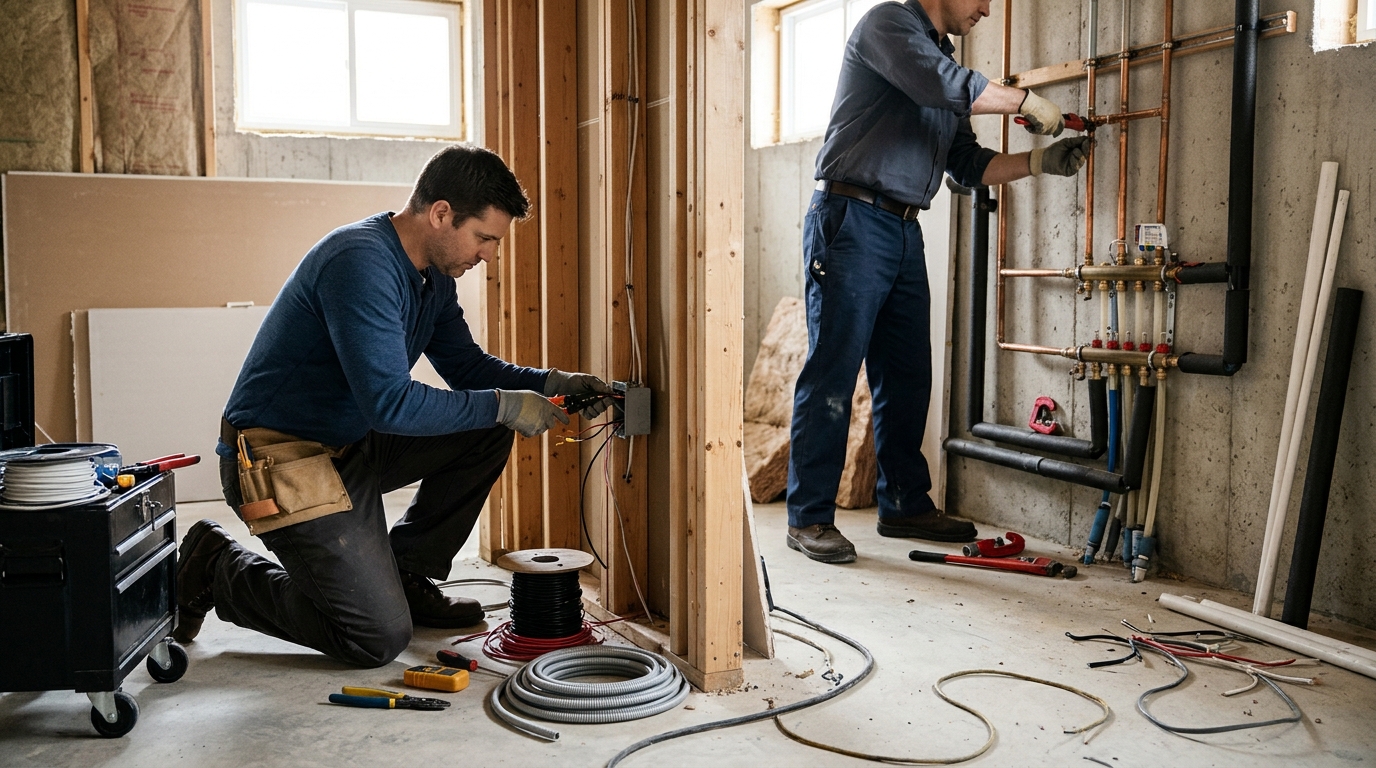
Electrician and plumber look almost identical on paper: a high school diploma to start, a 4- or 5-year paid apprenticeship, a state licensing exam, and median annual pay of $63,190 for electricians against $63,800 for plumbers, pipefitters and steamfitters in May 2025 (U.S. Bureau of Labor Statistics, 2025). The decision comes down to what is in your hands all day — conduit, panels and the National Electrical Code, or pipe, valves and a shutoff key on an emergency call.
This guide compares both trades on the same metrics, shows where the work genuinely overlaps, names the single biggest practical difference, and ends with a checklist you can score yourself against.
Electrician vs Plumber at a Glance
| Metric | Electrician | Plumber, pipefitter, steamfitter |
|---|---|---|
| Typical entry-level education | High school diploma or equivalent (U.S. Bureau of Labor Statistics, 2025) | High school diploma or equivalent (U.S. Bureau of Labor Statistics, 2025) |
| Median annual pay | $63,190, May 2025 (U.S. Bureau of Labor Statistics, 2025) | $63,800, May 2025 (U.S. Bureau of Labor Statistics, 2025) |
| Main training route | 4- or 5-year apprenticeship, about 2,000 paid on-the-job hours a year plus technical instruction (U.S. Bureau of Labor Statistics, 2025) | 4- or 5-year apprenticeship, about 2,000 paid on-the-job hours a year plus technical instruction (U.S. Bureau of Labor Statistics, 2025) |
| Entry barrier / licensing | Most states require passing a test covering the National Electrical Code and state and local electrical codes; requirements vary by state (U.S. Bureau of Labor Statistics, 2025) | Most states and some localities require a license, often 2 to 5 years of experience plus an exam; some states require master plumber status for a plumbing contractor's license (U.S. Bureau of Labor Statistics, 2025) |
| Preparation level | ONET Job Zone Three, Medium Preparation Needed (ONET OnLine, U.S. Department of Labor) | ONET Job Zone Three, Medium Preparation Needed (ONET OnLine, U.S. Department of Labor) |
| Typical hours | Almost all work full time; evenings and weekends possible and overtime common (U.S. Bureau of Labor Statistics, 2025) | Most work full time, including nights and weekends, often on call for emergencies (U.S. Bureau of Labor Statistics, 2025) |
| Physical demands | Cramped spaces, long periods of standing and kneeling, sometimes work at great heights (U.S. Bureau of Labor Statistics, 2025) | Lifting heavy materials, climbing ladders, tight spaces; cuts, burns from hot pipes and soldering equipment, falls from ladders (U.S. Bureau of Labor Statistics, 2025) |
| Signature daily task | Preparing sketches or following blueprints to locate wiring and equipment to building and safety codes (O*NET OnLine, U.S. Department of Labor) | Shutting off steam, water or other gases and liquids at pipe sections using valve keys or wrenches (O*NET OnLine, U.S. Department of Labor) |
| Common first job title | Apprentice electrician, then journeyman electrician after the apprenticeship and licensing exam | Apprentice plumber, then journeyman plumber, then potentially master plumber |
| Projected openings, 2025-2035 | About 72,700 a year on average, growth much faster than average for all occupations (U.S. Bureau of Labor Statistics, 2025) | About 42,000 a year on average, growth much faster than average for all occupations (U.S. Bureau of Labor Statistics, 2025) |
Pay varies by state, metro area, employer and whether the shop is union or non-union, and apprentice pay is usually a percentage of the journeyman rate that steps up as you log hours. Check current local figures on the Bureau of Labor Statistics Occupational Employment and Wage Statistics pages and with the apprenticeship programs you apply to.
Where These Careers Overlap
The training structure is nearly the same. Both trades are usually learned through a 4- or 5-year apprenticeship with about 2,000 hours of paid on-the-job training a year plus classroom instruction, and ONET places both in Job Zone Three, Medium Preparation Needed (U.S. Bureau of Labor Statistics, 2025; ONET OnLine, U.S. Department of Labor).
Two concrete tasks show up in both jobs. The first is reading construction drawings: an electrician prepares sketches or follows blueprints to locate wiring and equipment so the install conforms to building and safety codes, and a plumber works from the same drawing set to route supply and waste lines through the same walls and joists (O*NET OnLine, U.S. Department of Labor). On a framed house you will coordinate directly so neither of you drills through the other's run.
The second is code-driven inspection work. Both trades install to a published code, then have the work inspected before walls close up, so both spend time measuring clearances, labeling runs and correcting items an inspector flags. Both also work in tight spaces and climb ladders on the same jobsites (U.S. Bureau of Labor Statistics, 2025).
Where They Diverge
The biggest practical divergence is how unplanned your week is. Plumbers, pipefitters and steamfitters are often on call to handle emergencies on top of nights and weekends; electricians also work evenings and weekends with common overtime, but that time is more often booked in advance (U.S. Bureau of Labor Statistics, 2025).
Electrician scenario. A commercial tenant needs a panel replaced. The building cannot lose power during business hours, so the general contractor books the shutdown for a Saturday morning weeks ahead. You plan the sequence, prepare sketches against the blueprints so the new circuits land where the inspector expects them, and work a long scheduled day. You could plan your life around it.
Plumber scenario. Late on a Friday, a restaurant's main line backs up. You take the call, find the shutoff, close it with a valve key, clear the line and stay until the kitchen can run again. Nobody scheduled that, and the next call may come overnight.
The hazard profile diverges too. Electricians face work at great heights and long periods of standing and kneeling; plumbers lift heavy materials and risk cuts, burns from hot pipes and soldering equipment, and falls from ladders (U.S. Bureau of Labor Statistics, 2025). So does licensing: the electrician route centers on passing a code exam, while plumbing licenses often gate on 2 to 5 years of documented experience, with master plumber status sometimes required before you can hold a plumbing contractor's license (U.S. Bureau of Labor Statistics, 2025).
Which Path Fits You Better
Column A is electrician. Column B is plumber, pipefitter or steamfitter. Tick whichever side of each pair sounds more like you.
- Hours. A: I can commit to scheduled evenings, weekends and frequent overtime. B: I can answer an overnight emergency call and still work the next day.
- Physical demands. A: I am steady working at great heights on a lift or ladder for hours. B: I would rather haul cast iron pipe and fixtures than work high off the ground.
- Injury tolerance. A: I accept long stretches of kneeling in crawl spaces and attics. B: I accept cuts and burns from hot pipes and soldering equipment.
- Signature task. A: I want to lay out wiring runs from blueprints and make them conform to code. B: I want to diagnose a live system and shut it down at the valve first.
- Licensing route. A: I would rather study for an exam on the National Electrical Code plus state and local codes. B: I would rather log 2 to 5 years of documented experience, then sit the exam (U.S. Bureau of Labor Statistics, 2025).
- Business ambition. A: My goal is journeyman, then foreman on larger electrical installs. B: My goal is master plumber status so I can hold a plumbing contractor's license in my state.
- Openings. A: I want the larger pool, about 72,700 electrician openings a year, 2025-2035 (U.S. Bureau of Labor Statistics, 2025). B: About 42,000 plumber, pipefitter and steamfitter openings a year is plenty (U.S. Bureau of Labor Statistics, 2025).
- Pay. Neither column wins at the national median (U.S. Bureau of Labor Statistics, 2025). Tick the column where your local journeyman rate, checked against Bureau of Labor Statistics state and metro data and local apprenticeship programs, comes out ahead.
- First job title. A: Apprentice electrician with an electrical contractor. B: Apprentice plumber with a plumbing or mechanical contractor.
If you check more boxes in column A, apply to electrical apprenticeships and start studying the National Electrical Code. If column B, apply to plumbing or pipefitting apprenticeships and ask your state licensing board exactly how experience hours must be documented. If it is near even, shadow each trade for a day before you sign anything.
Frequently asked questions
Do electricians earn more than plumbers?
Not meaningfully at the national median: $63,190 for electricians and $63,800 for plumbers, pipefitters and steamfitters in May 2025 (U.S. Bureau of Labor Statistics, 2025). Local rates, union status and overtime matter more than the trade, so compare state and metro figures where you plan to work.
How long before I can work on my own as a plumber?
Most plumbers, pipefitters and steamfitters learn through a 4- or 5-year apprenticeship with about 2,000 hours of paid on-the-job training a year (U.S. Bureau of Labor Statistics, 2025). Licensing in most states and some localities adds an exam and often 2 to 5 years of experience.
Do I need college for either one?
No. Typical entry-level education for both electricians and plumbers, pipefitters and steamfitters is a high school diploma or equivalent, with the trade learned in a paid apprenticeship (U.S. Bureau of Labor Statistics, 2025). O*NET places both in Job Zone Three, Medium Preparation Needed (O*NET OnLine, U.S. Department of Labor).
Sources
- U.S. Bureau of Labor Statistics — Electricians : Occupational Outlook Handbook (2025)
- U.S. Bureau of Labor Statistics — Plumbers, Pipefitters, and Steamfitters : Occupational Outlook Handbook (2025)