Electrician Salary: What to Expect
Where electrician pay actually comes from — wage tables, licence tier, employer type, union agreements and overtime — and how to read them before you sign on.
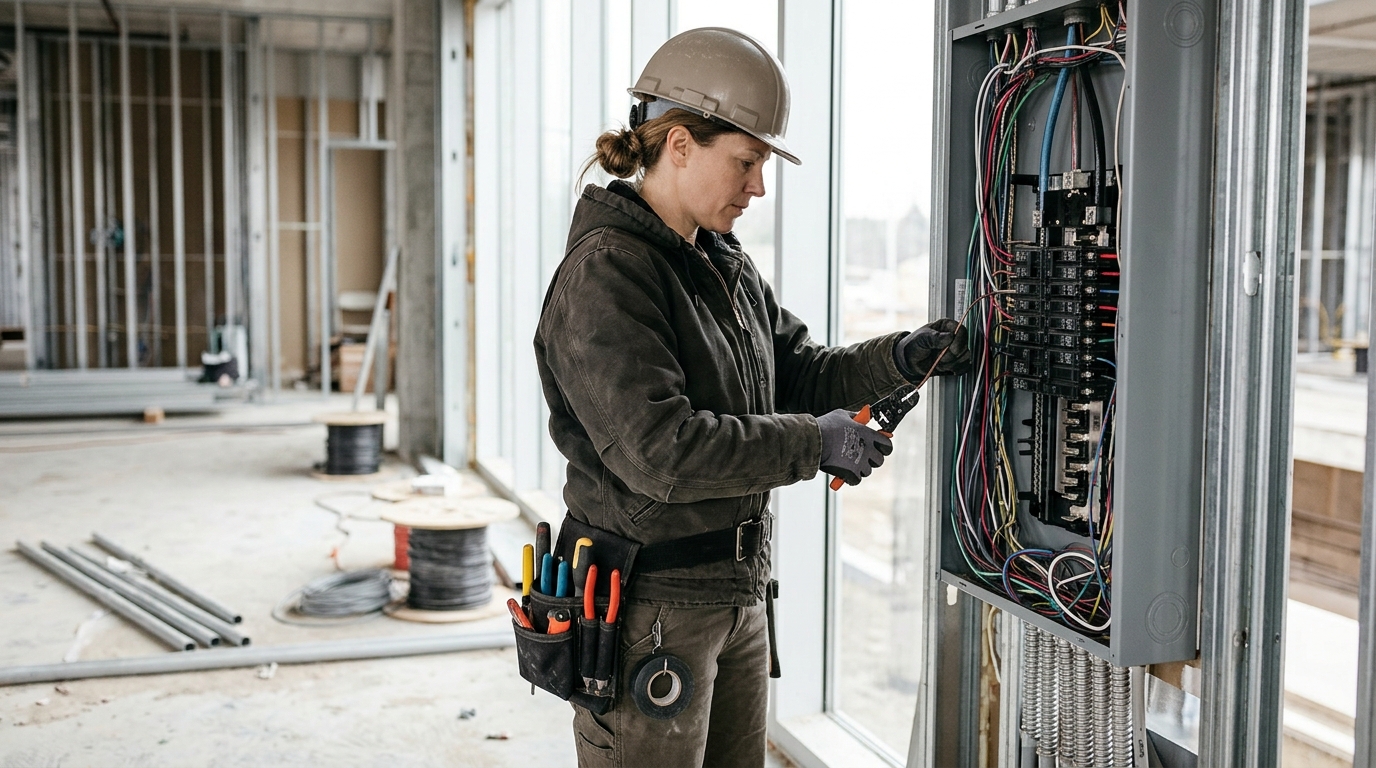
Electricians are almost always paid an hourly rate on the job, which employers and job ads then convert into an annual salary. The U.S. Bureau of Labor Statistics publishes a median annual wage for electricians as of May 2025, along with the 10th and 90th percentile figures that mark the bottom and top of the field, so you can see the whole spread rather than one average (U.S. Bureau of Labor Statistics, 2025).
What you personally earn depends on your licence tier, your state, whether you work for an electrical contractor, a manufacturer or a government body, whether your shop is union or non-union, and how much overtime you take. This guide explains how each of those moves the number and exactly which tables to open to get the current figure for your situation.
What the Typical Electrician Earns
The authoritative national number is the median annual wage for electricians as of May 2025, published by the U.S. Bureau of Labor Statistics in its Occupational Employment and Wage Statistics (OEWS) program. The median is the midpoint: half of electricians earned more than that figure and half earned less. BLS also publishes the 10th percentile — the amount the lowest-paid 10 percent of electricians earned less than — and the 90th percentile, the amount the highest-paid 10 percent earned more than (U.S. Bureau of Labor Statistics, 2025). Those two numbers are the honest edges of the field, and the distance between them is wide.
You will also see a national mean (average) annual wage for electricians from the same May 2025 OEWS release, reported by wage trackers such as WageDex citing BLS OEWS (2025). The mean and the median are not interchangeable. The mean is pulled upward by the top earners — high-overtime industrial work, master electricians, foremen — so it usually sits above the median. Where this guide refers to a typical figure, it means the median unless the word mean or average is used.
BLS also breaks the May 2025 median down by industry, with separate medians for electricians working in government (excluding state and local education and hospitals), in manufacturing, and for electrical contractors and other wiring installation contractors (U.S. Bureau of Labor Statistics, 2025). Comparing those three medians against each other is the quickest way to see what sector choice is worth to you.
Two more figures are worth looking up alongside pay: the number of electrician jobs in 2025 and the projected job outlook for 2025–2035, both from BLS (2025). A growing occupation gives you more leverage when you negotiate, because employers competing for licensed hands have less room to hold the rate down.
One caution on units. Electricians are commonly quoted both ways — an hourly rate on the job site, an annual salary in a job ad. Do not convert between the two without stating your assumption. If you annualize an hourly rate, write down the hours per week and weeks per year you are using, and note separately whether overtime is included, because on construction and industrial work overtime is often a large share of actual annual earnings.
Where to check current rates: the BLS OEWS page for electricians (occupation code 47-2111) for national and state figures, your state workforce agency for local detail, and, if the job is union, the current collective bargaining agreement for the local covering that jurisdiction.
Pay by Experience Level
Electrician pay is tiered by licence, not just by years served. The tiers below are the ones employers actually hire against; the figures attached to each tier change by state and year, so the right-hand column tells you where to read them.
| Stage | What separates this tier | Where to find the current figure |
|---|---|---|
| Entry-level (apprentice, helper) | No licence yet; working under supervision and logging hours. Entry-level and apprentice electricians typically earn near the bottom of the BLS national wage range (JadeLearning). Apprentice rates are usually set as a stepped percentage of the journeyman rate that rises as you complete hours and classroom periods. | BLS 10th percentile for electricians, May 2025 (U.S. Bureau of Labor Statistics, 2025); the apprentice wage schedule in the agreement or employer policy covering your program. |
| Mid-career (journeyman) | Licensed to work unsupervised. You must complete a set period of work after your apprenticeship before you are eligible to test for journeyman certification (GVEC). This is the tier the national median is built around. | BLS median annual wage for electricians, May 2025, and your state median in the same OEWS release (U.S. Bureau of Labor Statistics, 2025). |
| Experienced / senior (master, foreman, general foreman) | A master licence requires additional work experience after you hold a journeyman licence (GVEC). Foremen and general foremen are paid a premium above the journeyman rate for crew and job responsibility (BuildForce). Senior earners also cluster in high-overtime industrial and government work. | BLS 90th percentile for electricians, May 2025 (U.S. Bureau of Labor Statistics, 2025); the foreman and general foreman premiums written into your local agreement. |
Never treat a single "typical electrician salary" as covering all three tiers. An apprentice rate and a master or foreman rate are different numbers, and job ads that quote one broad range are usually describing the whole span between them.
What Affects Pay
- Your state. BLS Occupational Employment and Wage Statistics for 2025 supports rankings of state medians, and the gap between the highest-paying and the lowest-paying state for electricians is substantial (nuecareer.com citing BLS OEWS, 2025). To size it for yourself, subtract the lowest state's median from the highest state's median in that ranking, then find where your own state falls. Never assume the national median applies locally.
- Employer type and industry. BLS publishes separate May 2025 medians for electricians in government (excluding state and local education and hospitals), in manufacturing, and with electrical contractors and other wiring installation contractors (U.S. Bureau of Labor Statistics, 2025). The difference between those industry medians is the measurable value of a sector switch — compare the three directly before you move.
- Licence tier. Moving from apprentice to journeyman, and later from journeyman to master, are the step changes in this trade. Each requires documented time: a set period after your apprenticeship to test for journeyman, and further experience after that to test for master (GVEC). The size of each step in dollars is the gap between the BLS 10th percentile, median and 90th percentile for May 2025.
- Union membership. Federal data show a difference between union members' median weekly earnings and those of non-union workers (ULA Network), and union journeyman electricians earn a premium over non-union counterparts in most markets (BuildForce). The exact premium is market-specific: compare the journeyman rate in the local agreement with non-union offers in the same metro.
- Supervisory scope. Electrical foremen and general foremen are paid above the journeyman rate (BuildForce). That premium is normally a defined percentage or cents-per-hour uplift written into the agreement or the employer's pay schedule, so you can read it before you take the role.
- Overtime, shift and premium time. Because most electricians are paid hourly, scheduled overtime, night shift differentials and premium-rate call-outs can make annual earnings differ sharply between two people on the same base rate. Ask what the expected weekly hours are, and whether overtime is at time-and-a-half or double time.
Pay by State or Metro Area
The rows below are the state-level comparisons published from the May 2025 OEWS release. They are listed alphabetically, not by pay, because the figures change with each annual release — open the source column and read the current number rather than relying on a ranking that may have shifted.
| State | Figure published | Where to read it |
|---|---|---|
| Illinois | Median annual wage for electricians, May 2025 OEWS | Workforce Intelligence Lab, citing BLS OEWS, 2025 |
| Massachusetts | Median annual wage for electricians, May 2025 OEWS | Workforce Intelligence Lab, citing BLS OEWS, 2025 |
| Washington | Median annual wage for electricians, May 2025 OEWS | Workforce Intelligence Lab, citing BLS OEWS, 2025 |
| Highest-paying state | Highest state median annual wage for electricians | nuecareer.com, citing BLS OEWS, 2025 |
| Lowest-paying state | Lowest state median annual wage for electricians | nuecareer.com, citing BLS OEWS, 2025 |
Source for all rows: BLS Occupational Employment and Wage Statistics, May 2025 release, as reported by the trackers named in each row.
Two things to do with this table. First, pull your own state's median and compare it with the national median — that difference, in dollars, is your local adjustment. Second, go one level deeper: OEWS also publishes metropolitan area wage data, and within a single state a dense urban metro and a rural county can sit a long way apart. A high state median usually reflects a high cost of living too, so weigh any move against rent and commuting costs, not the wage alone.
How to Increase Your Earnings
- Finish the apprenticeship and log your hours cleanly. Apprentices sit near the bottom of the national wage range (JadeLearning), and the fastest way out of that band is a complete, documented hour log. Keep your own records as well as the employer's.
- Test for journeyman as soon as you are eligible. You must complete a set period of work after your apprenticeship before you can test for journeyman certification (GVEC). Diary the eligibility date and apply in the first testing window you qualify for — every month you wait is a month at the lower rate.
- Add the master licence. A master electrician licence requires additional work experience after you hold a journeyman licence (GVEC). It opens pulling permits, running work and, in many states, owning a contracting business — the route most electricians take into the top wage decile BLS reports for May 2025 (U.S. Bureau of Labor Statistics, 2025).
- Compare the union and non-union rate in your own market. Federal data show union members' median weekly earnings differ from non-union workers' (ULA Network), and union journeymen earn a premium in most markets (BuildForce). Get the current local agreement, find the journeyman rate and benefit contributions, and set them against your current package line by line.
- Move toward the better-paying sector, not just the better-paying job. BLS publishes different May 2025 medians for electricians in government, manufacturing and electrical contracting (U.S. Bureau of Labor Statistics, 2025). Work out the dollar difference between your sector's median and the one you are considering before you commit to a move.
- Take the foreman step when it is offered. Foremen and general foremen are paid above the journeyman rate (BuildForce). Ask for the exact premium in writing, and ask whether it applies to all hours or only to hours worked in the foreman role.
- Negotiate with the table open. Bring your state's OEWS median and the 90th percentile for May 2025 to the conversation, state the licence tier and overtime expectation you are being asked to cover, and ask for a specific hourly rate rather than an annual figure. If the employer will not move the base rate, negotiate the shift differential, the per-diem, the tool allowance or the licence renewal and continuing-education costs instead.
Frequently asked questions
Are electricians paid hourly or on a salary?
Overwhelmingly hourly on field work, with the annual figures you see — including the BLS median for May 2025 — derived from those rates. Salaried arrangements show up mainly in supervisory, estimating, facilities and some government roles. If you annualize an hourly rate yourself, state your assumption, such as 40 hours a week over 52 weeks, and keep overtime as a separate line, because on construction work it can be a large part of actual annual earnings.
How long before I'm earning the journeyman rate?
You have to serve the apprenticeship and then complete a further set period of work before you are eligible to test for journeyman certification (GVEC), and more experience again after that to test for master. Until then you are typically on an apprentice schedule that steps up as you complete hours. In 2025 terms, plan your earnings around the BLS 10th-percentile end of the range for the apprentice years rather than the median.
Does the national median apply to my city?
No. The May 2025 OEWS release publishes separate state medians — Illinois, Washington and Massachusetts each have their own, reported by Workforce Intelligence Lab citing BLS OEWS (2025) — and the highest-paying and lowest-paying states sit a long way apart (nuecareer.com citing BLS OEWS, 2025). Metro-level data goes a step finer, and within one state an urban metro and a rural county can differ materially.
Is union work worth it financially?
Federal data show a difference between union members' median weekly earnings and non-union workers' earnings (ULA Network), and union journeyman electricians earn a premium over non-union counterparts in most markets (BuildForce). The honest answer for your situation comes from the current local agreement: compare the 2025 journeyman rate, plus pension and health contributions, with your non-union total package rather than base pay alone.
Which industry pays electricians best?
BLS published separate May 2025 medians for electricians in government (excluding state and local education and hospitals), in manufacturing, and with electrical contractors and other wiring installation contractors (U.S. Bureau of Labor Statistics, 2025). Rank those three yourself in the current release. Bear in mind the trade-offs: government work often brings steadier hours and benefits, while contracting and industrial work can carry more overtime and more travel.
Is demand for electricians growing?
BLS published both the number of electrician jobs in 2025 and a projected outlook for the 2025–2035 decade (U.S. Bureau of Labor Statistics, 2025). Check the projected growth rate on the occupational outlook page — a growing occupation strengthens your position when you negotiate a rate, because employers have fewer licensed alternatives to hire instead.
Sources
- U.S. Bureau of Labor Statistics — Electricians : Occupational Outlook Handbook (2025)
- WageDex (citing BLS OEWS) — Electricians Salary: $63,190/yr (2025) (2025)