How to Get an Entry-Level Job With No Experience: Step-by-Step Guide
Turn school projects, volunteering and unpaid tasks into evidence an employer can check, then apply in a sequence that gets you interviews faster.
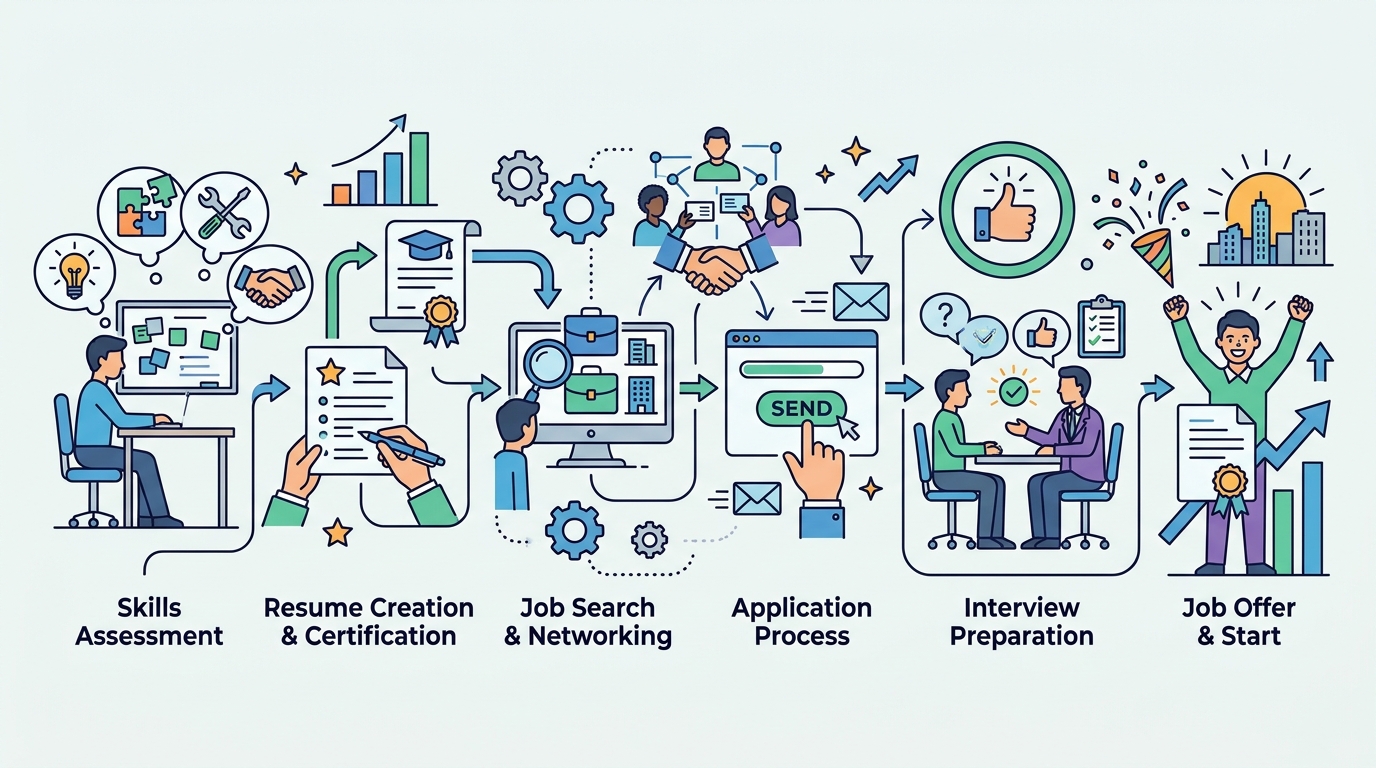
You can get hired into an entry-level job without paid work history, but you have to replace experience with evidence: coursework, volunteering, caregiving, side projects and short certifications that show you can do specific tasks. The work is front-loaded — one solid resume, one target list, a few rehearsed stories — and then repeated at volume until something lands.
How long it takes depends heavily on the sector and the employer. High-volume hourly roles can move from application to offer in days; large corporate programs, school districts and city, state or federal government hiring usually run on fixed cycles that take months.
Typical Timeline to Land the Job
These ranges are a common pattern for entry-level hiring, not a guarantee. Many employer postings state their own expected timeline or a closing date, and that posting beats any general estimate — read it first. For entry requirements by occupation, the BLS Occupational Outlook Handbook is the standard reference; your state workforce agency usually publishes local hiring information too.
- Week 1 — preparation. You finish a one-page resume, a short cover letter template and a target list of 20 to 30 employers. Milestone: your first application goes out by day 5 to 7.
- Weeks 1 to 3 — volume applying. You send 40 to 60 applications. Entry-level postings attract large applicant pools, so a response rate in the single digits per batch is normal and is not a signal to stop.
- Weeks 2 to 4 — first contact. Milestone: your first phone or video screen, usually 15 to 25 minutes, often with a recruiter or shift manager rather than the hiring manager.
- Weeks 3 to 8 — interviews and assessments. A second round, a short skills test, a tour of the site or a working trial. Retail, warehouse, food service and call centre employers sometimes compress screen, interview and offer into one visit.
- Weeks 4 to 12 — offer and onboarding. Milestone: a written offer, then background or reference checks before a start date. Government and school employers commonly run longer than this because of fixed posting windows and board approvals.
- Ongoing. Keep applying until you have signed something. Verbal interest is not an offer.
Timelines also vary by country. This guide describes US hiring practice; application norms, document names and background-check steps differ elsewhere.
Step-by-Step Plan
1. Inventory what you have actually done. Spend 90 minutes listing every task from school, volunteering, clubs, caregiving, sports, church, gaming communities or informal paid work. Write the task, how often, and how many — "ran the sign-in table at 12 events, averaging 70 attendees." This list becomes your resume. 2. Write one base entry-level resume. One page, standard headings: Summary, Skills, Experience, Education. With no job history, put Skills above Experience, and label unpaid work honestly as Volunteer Experience or Projects. Every bullet gets a number: - "Logged and shelved 400+ donated items per weekend shift at a community food pantry; trained 3 new volunteers on the intake process." - "Built a 12-tab spreadsheet for a 6-week group project, cutting weekly reporting from 2 hours to 20 minutes for 5 classmates." - "Handled cash and card payments across 40 shifts at a school fundraiser stand, closing the till with no shortages." 3. Build a target employer list. Pick 20 to 30 employers that hire entry-level staff continuously — distribution centres, grocery and retail chains, hospitals and clinics for patient transport or food service, call centres, hotels, school districts, municipal parks and public works. Mix fast hirers with slow ones so you always have something moving. 4. Tailor for the applicant tracking system. Copy the three or four exact task phrases from the posting — "inventory counts," "point-of-sale," "patient intake," "order picking" — and use the same wording in your Skills section and in one bullet, only where it is true. Keep the file to a single column with no text boxes, tables, graphics or content in the header and footer, because those often parse incorrectly. Save as FirstLast_Resume.pdf unless the posting asks for .docx. 5. Apply in daily batches. Five applications a day beats 25 on a Sunday. Track role, employer, date applied, source and next action in one spreadsheet so you never apply twice or miss a follow-up date. 6. Prepare four STAR stories. One about a deadline, one about a conflict, one about learning something new, one about a mistake. Rehearse them out loud at 90 seconds each.
"Tell me about a time you handled a difficult situation."
Situation: I volunteer at a food pantry, and one Saturday two volunteers did not show up with about 50 people already waiting outside. Task: I was responsible for intake — checking names against the paper log and handing out numbered tickets. Action: I moved the intake table to the door, split the line into first-time and returning visitors, and logged returning visitors from the existing sheet instead of filling out a new form for each one. Result: We cleared the line in about 40 minutes instead of the usual 90, and the coordinator asked me to run intake for the next six weeks.
- Handle the offer conversation with facts, not guesses. Entry-level pay is usually hourly, sometimes with shift differentials, overtime rules or tip structures, and benefits often start after a waiting period. Check the posted range, the BLS Occupational Outlook Handbook, your state workforce agency and employer-reported ranges on sites such as Glassdoor or Indeed before you answer. Several states require employers to publish a pay range in the posting and restrict pay-history questions, and those rules differ state by state — read the posting and your state labor department's guidance.
Resume vs. Cover Letter vs. LinkedIn
| Content item | Resume | Cover letter | |
|---|---|---|---|
| Name, phone, email, city/state | Yes, top line | Yes, in the sign-off | Phone and email in Contact Info only |
| Professional summary (2 lines) | Yes | No — the letter is already the long version | Replaced by the About section |
| Headline | No | No | Yes: target role plus one skill, e.g. "Entry-Level Warehouse Associate — forklift certified" |
| Skills section with posting keywords | Yes, 8 to 12 items | No list — name two in a sentence | Yes, Skills section with endorsements |
| Volunteer, class projects, caregiving | Yes, as dated entries with numbers | Yes, one expanded as a short story | Yes, under Volunteer Experience |
| Why this employer specifically | No | Yes — one sentence naming something real about the site or role | No |
| Explanation of no work history or a gap | No | Yes, one sentence, no apology | No |
| Availability, shifts, reliable transport | Only if the posting asks | Yes, one line | About section, optional |
| Certifications (food handler, OSHA, CPR, forklift) | Yes, with date earned | Mention only if it is a posting requirement | Yes, Licenses & Certifications |
| References | No — "available on request" is not needed | No | Recommendations instead |
| Photo | No | No | Yes, plain headshot |
Where the three overlap, the format changes, not the content. Your strongest volunteer entry appears as a numbered bullet on the resume, as a three-sentence story in the cover letter, and as a dated entry on LinkedIn. Keep job titles, dates and employer names identical across all three — recruiters compare them, and mismatched dates are a common reason entry-level applications stall.
Follow-Up After the Interview
- Within 2 hours of leaving, write down each interviewer's name and title and one specific question they asked.
- Within 24 hours, send a separate thank-you email to each interviewer naming one duty from the role you discussed.
- Within 24 hours, email any document you promised — certification copy, reference list, availability grid — as a PDF named FirstLast_References.pdf.
- Within 48 hours, update your tracker with the interview date, stage reached and the decision date you were given.
- On day 3, send a LinkedIn connection request to the hiring manager with a one-line note referencing the interview.
- One business day after the stated decision date passes with no reply, send a three-sentence follow-up asking where the process stands.
- Seven days after that follow-up with no reply, send one final short message, then mark the role closed in your tracker.
- Submit at least five new applications in the week after any interview, and stop only once you have a written offer in hand.
Frequently asked questions
What actually counts as experience if I have never been paid for work?
Employers are looking for proof you can show up, follow a process and handle people or equipment safely — paid status is secondary. Coursework with deadlines, volunteering, running a club budget, caring for a relative, reselling online or managing a team in a game all qualify if you can describe the task and attach a number. List them under Volunteer Experience or Projects with real dates rather than inventing a job title.
Should I apply if I meet only some of the listed requirements?
Apply if you meet the hard requirements — age, license, certification, physical requirements, legal right to work — and most of the core duties. Entry-level postings often list preferred software or years of experience that the employer treats as nice-to-have. Skip the ones where a required certification is missing and spend that time getting the certification instead.
Is it faster to start with temp, seasonal or staffing-agency work?
Often yes, because staffing agencies and seasonal hiring run on shorter cycles and are built to take people with thin resumes. A completed 90-day assignment gives you a verifiable employer, a supervisor reference and a dated resume entry, which makes the next application much easier. Ask the agency up front whether assignments convert to permanent roles and how often that happens there.
How do I answer "walk me through your resume" when there is barely anything on it?
Spend 20 seconds on education, then move straight to the most relevant unpaid thing you have done and describe the task in the same vocabulary as the job posting. End by connecting it to the role: "that is the part I liked, and it is why I applied for the stocking shift here." Do not narrate the empty years or apologise for them.
How many applications should I send before I change my approach?
If 30 to 40 tailored applications produce no screens at all, the problem is usually the resume format or the targeting, not the market. Have someone read your resume cold for 30 seconds and tell you what job you are applying for; if they cannot say, rewrite the headline, summary and skills section. Also check that your file opens cleanly as a single-column PDF with no tables.