How to Get Promoted to Team Lead in Software Engineering
What changes when you stop writing code full time, how long the move usually takes, and the concrete steps that put you in front of the hiring manager.
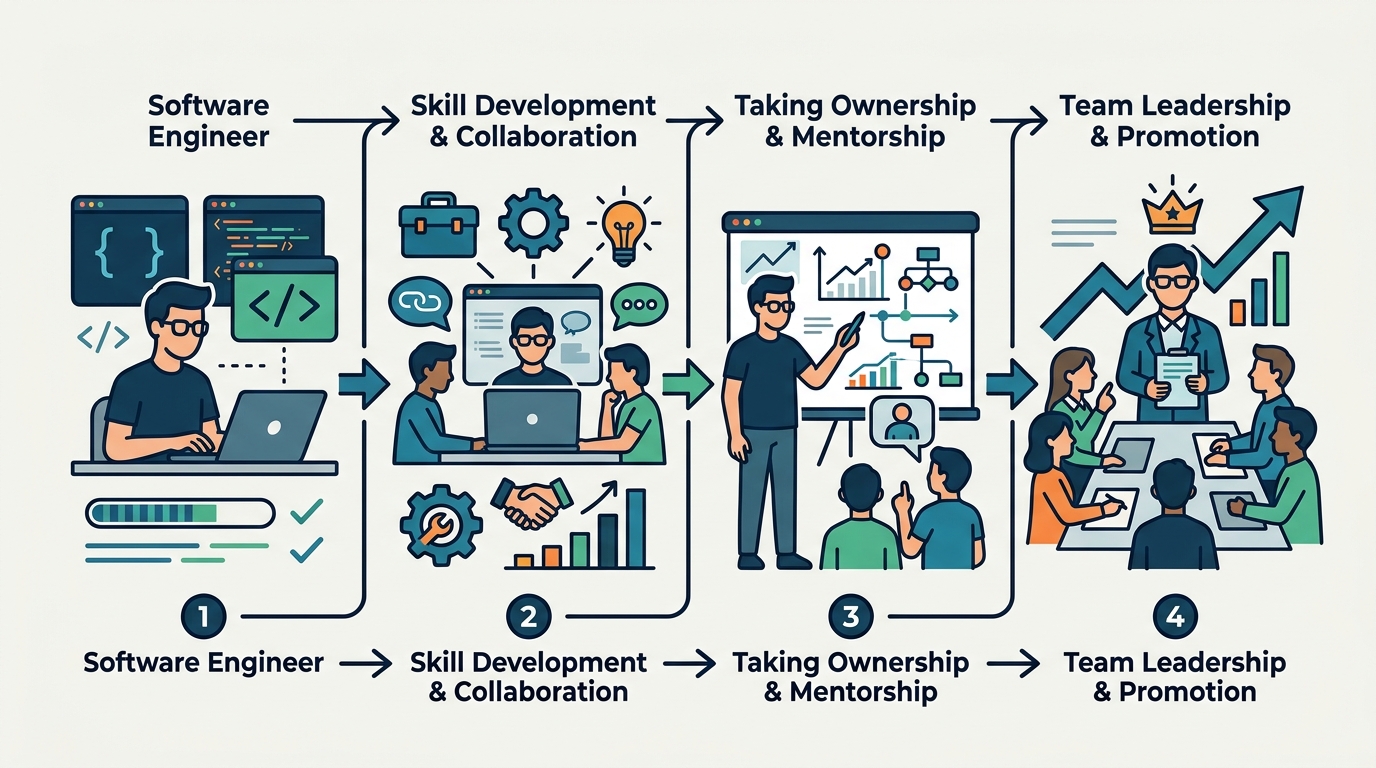
Getting promoted to team lead in software engineering is usually an internal move, earned by taking on coordination work — code review ownership, onboarding new hires, running standups, breaking down epics — before the title exists. Most engineers who make the jump spend 6 to 18 months visibly doing parts of the job first, then apply through an internal posting or ask their manager to open a role.
The pay change is rarely dramatic at the first rung. Senior individual contributors and first-line leads often sit in overlapping bands, and the bigger jump comes later at the manager level, where the U.S. Bureau of Labor Statistics lists a median of $175,140 for Computer and Information Systems Managers (2025) against $134,040 for the Software Developers, QA Analysts, and Testers group (2025).
Old Path vs New Path Compared
The comparison below is between staying on the individual contributor track as a software developer and moving onto the people-leadership track that starts at team lead and runs up to engineering manager. Pay bands vary widely by employer, metro area and whether the company treats team lead as a role or a title, so check current postings and your own company's levelling guide rather than assuming the national figures apply to you.
| Attribute | Software developer (IC track) | Team lead / engineering management track |
|---|---|---|
| Published pay benchmark | Median $134,040 for the Software Developers, Quality Assurance Analysts, and Testers group (U.S. Bureau of Labor Statistics, 2025) | Median $175,140 for Computer and Information Systems Managers (U.S. Bureau of Labor Statistics, 2025); first-line lead roles usually sit below this and closer to senior IC bands |
| Typical entry-level education | Bachelor's degree (U.S. Bureau of Labor Statistics, 2025) | Bachelor's degree (U.S. Bureau of Labor Statistics, 2025), plus demonstrated delivery experience |
| Common credentials | None required; language and cloud certifications optional | Certified ScrumMaster, which requires a course taught by a Certified Scrum Trainer and a Scrum Alliance exam (Simplilearn, undated); PMP, which PMI describes as demonstrating a minimum amount of project-leadership experience (PMI, undated) |
| Outlook signal | — | ONET lists Computer and Information Systems Managers (SOC 11-3021.00) as a 'bright outlook' career (West Virginia University Careers, citing ONET OnLine) |
| Weekly hours | Usually salaried full time; crunch tied to release dates | Usually salaried full time with more fragmented days; on-call escalation and incident coordination often land on the lead |
| Day-to-day demands | Deep focus blocks, pull request work, debugging | Context switching between one-to-ones, sprint planning, PR triage and roadmap conversations; stress shifts from solving problems to being accountable for other people's deadlines |
The honest trade: your calendar fragments. A lead's day often runs standup, two one-to-ones, a design review, an incident retro and whatever code review backlog is blocking the team — with coding squeezed into the gaps or dropped entirely.
Step-by-Step Transition Plan
- Audit the role as your company defines it (Weeks 1-2). Pull the internal job architecture or levelling guide and read the team lead description line by line. Note which expectations you already meet and which you have never been given a chance to demonstrate.
- Tell your manager you want the track (Week 2-3). Say it explicitly in a one-to-one, not as a hint. Ask what evidence they would need to see and what the promotion process is — committee review, calibration cycle, or an internal job posting you apply to like any other candidate.
- Take ownership of one delivery ritual (Months 1-3). Volunteer to run sprint planning, backlog refinement or the retro for your team. This is the single clearest signal, because it is visible to everyone in the room every week.
- Earn the Certified ScrumMaster credential (Months 2-4). The course has no formal prerequisites, though familiarity with Agile concepts helps (Simplilearn, undated). You complete a course taught by a Certified Scrum Trainer, then pass a 50-question multiple-choice exam administered by the Scrum Alliance (Simplilearn, undated).
- Own onboarding for a new hire or intern (Months 3-6). Write the ramp-up plan, pair with them on their first three tickets, and run weekly check-ins. Mentoring one person well is the most portable evidence you will collect.
- Lead a cross-team project end to end (Months 4-9). Take something with real dependencies — a migration, an API version cutover, a compliance deadline — and own the breakdown, the status updates and the risk calls. Keep a written record of scope changes and how you handled them.
- Apply through the internal posting or request the role formally (Months 6-12). When a seat opens, apply through your company's internal mobility system rather than waiting to be tapped. If no seat exists, ask your manager to raise headcount or team-split options at the next planning cycle.
- Consider the PMP only if your path runs toward programme delivery (Month 12+). PMI lists an eligibility path based on a high school diploma, GED or equivalent plus a stated amount of project-managing experience (PMI, undated), and describes the credential as demonstrating a minimum amount of project-leadership experience (PMI, undated). It carries more weight in enterprise and consulting environments than in product startups.
Skills and Experience You'll Need to Bridge
- Running a planning cadence. Standups, refinement and retros are mechanical skills you learn by doing, not reading. Close it by taking over facilitation for your current team for a full quarter, and back it with the Certified ScrumMaster course and Scrum Alliance exam (Simplilearn, undated).
- Breaking epics into estimable work. Leads are judged on whether the team's commitments hold. Close it by volunteering to write the ticket breakdown for the next large feature, then comparing your estimates against actuals at the end of the sprint and writing up what drifted.
- Giving feedback that changes behaviour. Code review comments are not performance feedback. Close it by mentoring one new hire or intern through a full onboarding cycle, including a written mid-point check-in and a documented ramp plan.
- Incident and escalation ownership. Close it by joining the on-call rotation as incident commander rather than responder, and by writing two or three blameless postmortems that go out to the wider engineering org.
- Stakeholder translation. Product managers, support and sales ask engineering questions in non-engineering terms. Close it by sitting in on the next quarterly roadmap session and volunteering to write the engineering status summary that goes to non-technical readers.
- Hiring and interviewing. Close it by joining your company's interview panel, getting trained as a technical interviewer, and doing enough loops to be trusted with debriefs.
- Formal project delivery vocabulary, if your employer is enterprise or regulated. Close it with the PMP route, where PMI describes one eligibility path as a high school diploma, GED or equivalent plus a stated amount of project-managing experience (PMI, undated).
Sample Pitch: Explaining the Switch
Use this in a promotion conversation with your manager, or in an internal interview panel. Swap in your own specifics — the pitch only works if the examples are checkable.
Making the case for a team lead role
I want to move onto the lead track, and I've been doing parts of the job for the last two quarters so you can judge it on evidence rather than intent. I've been running sprint planning and retros for our team since the spring, and I owned the ticket breakdown and dependency mapping for the payments migration, which shipped two days inside the window we committed to. I onboarded our last backend hire — wrote the ramp plan, paired through their first three tickets, and they were merging unsupervised in four weeks. I completed the Certified ScrumMaster course and exam through the Scrum Alliance to make sure I wasn't just improvising the process side. What I want to know from you is which parts of the lead expectations I haven't demonstrated yet, and whether the next seat will be an internal posting I should apply to or something that goes through calibration.
Timeline: What to Expect
- Weeks 1-4 — Intent and baseline. You state the goal to your manager, read the levelling guide, and agree on two or three specific gaps. You should leave this period with a written list of evidence you need to collect.
- Months 1-4 — Visible ownership begins. You take over a planning ritual and complete the Certified ScrumMaster course and Scrum Alliance exam, which is a 50-question multiple-choice test (Simplilearn, undated). Your teammates start routing coordination questions to you instead of your manager.
- Months 4-9 — Delivery evidence. You lead one cross-team project end to end and mentor at least one new hire through onboarding. This is the stretch where most of the usable promotion evidence gets created.
- Months 6-18 — The seat opens. Timing here is outside your control. It depends on headcount, team growth, or an existing lead moving on — which is why engineers in flat or shrinking teams sometimes have to move companies to get the title.
- Months 12-24 — First year in role. You carry a small team, run one-to-ones and performance input, and your coding time drops sharply. If the management track suits you, the next published benchmark ahead is the Computer and Information Systems Managers median of $175,140 (U.S. Bureau of Labor Statistics, 2025), a role ONET flags as 'bright outlook' (West Virginia University Careers, citing ONET OnLine, SOC 11-3021.00).
Frequently asked questions
Will I take a pay cut moving from senior engineer to team lead?
A cut is unusual, but a flat move is common, because many employers place first-line leads in a band that overlaps with senior individual contributors. The published gap is between the broad developer group median of $134,040 and the Computer and Information Systems Managers median of $175,140 (U.S. Bureau of Labor Statistics, 2025), and most of that gap sits above team lead rather than at it. Ask HR or your manager for the exact band before you accept, since bands differ by employer and by state.
Do I need a certification to be promoted internally?
No employer requires one to hand you a team, but a credential closes a credibility gap when you have never formally run a process. The Certified ScrumMaster has no formal prerequisites, though familiarity with Agile concepts helps, and it requires a course taught by a Certified Scrum Trainer plus a Scrum Alliance exam (Simplilearn, undated). The PMP is better suited to enterprise and consulting settings, since PMI describes it as demonstrating a minimum amount of project-leadership experience (PMI, undated).
How much coding will I still do?
Expect it to drop and keep dropping. In the first year you may still pick up small tickets, handle code review and stay on the on-call rotation, but planning, one-to-ones and unblocking others will take the hours you used to spend in deep focus. Leads who insist on staying on the critical path usually become the bottleneck for their own team.
What if no lead role opens on my team?
That is the most common blocker and it is structural, not personal. Options are to ask your manager about leads on adjacent teams, to push for a team split at the next planning cycle if headcount is growing, or to take the evidence you have built to an external role. Keep the written record of what you owned, because external interviews will test it harder than internal ones.
Is team lead the same as engineering manager?
Usually not. Team lead is often a working role with coordination duties and limited formal authority, while engineering manager typically carries performance reviews, hiring decisions and budget input — the territory the Bureau of Labor Statistics covers under Computer and Information Systems Managers (2025). Some companies use the titles interchangeably, so read the internal job description rather than the title.
Can I go back to being an individual contributor if I don't like it?
At most companies with a dual-track ladder, yes, and it is treated as a lateral move rather than a demotion. The risk is skill drift: a year or two away from daily implementation makes the return harder, so keep reviewing code and stay current with your team's stack. Ask during the promotion conversation whether the company has a documented path back, because not all of them do.
Sources
- U.S. Bureau of Labor Statistics — Computer and Information Technology Occupations : Occupational Outlook Handbook (2025)
- U.S. Bureau of Labor Statistics — Management Occupations : Occupational Outlook Handbook (2025)