Is Dental Hygienist or Registered Nursing Better Paying?
Median pay for the two sits within $550 of each other, but entry floors, top-end ceilings, hours and state differences pull them apart in opposite directions.
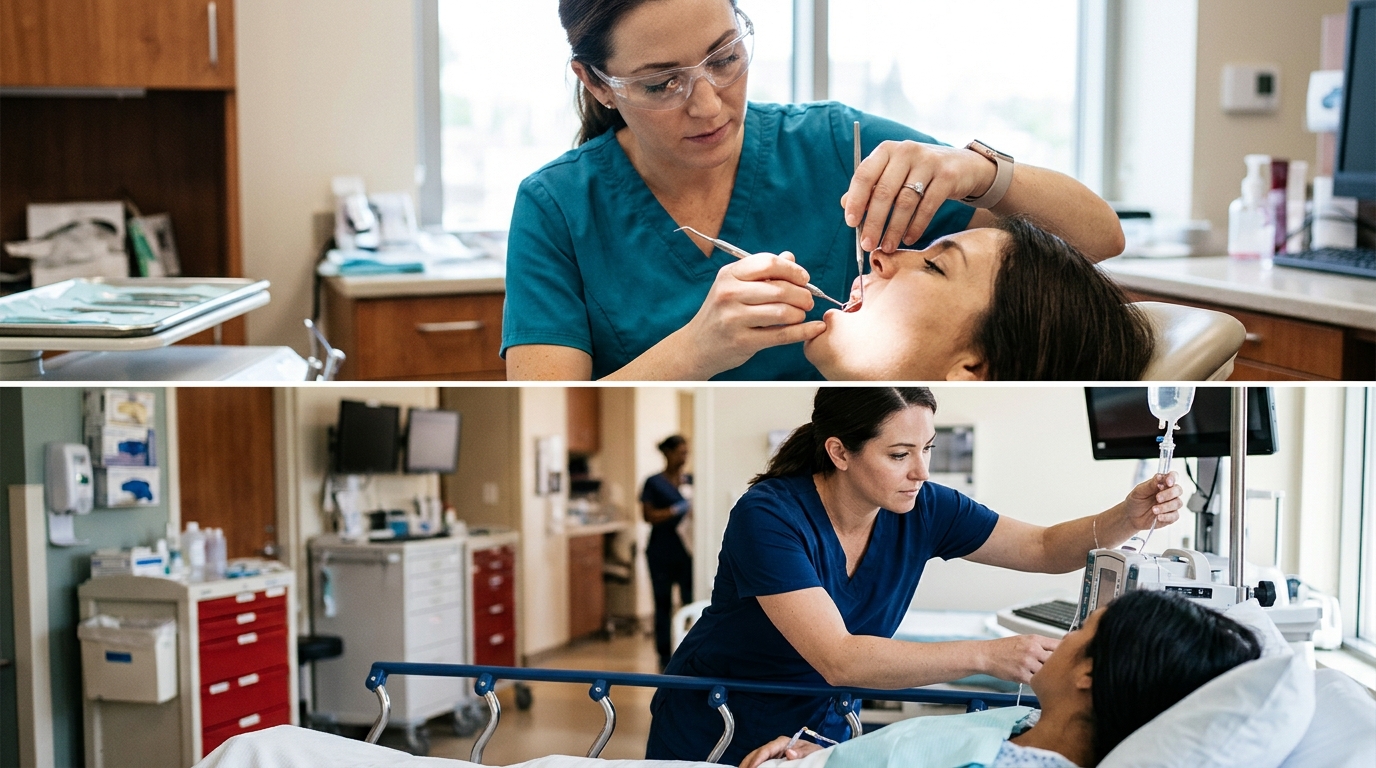
At the national median the two are almost level: $98,100 a year for dental hygienists and $97,550 for registered nurses in May 2025, a difference of $550 (U.S. Bureau of Labor Statistics, 2025). The gap shows up at the ends instead — hygienists start higher, while the best-paid 10% of nurses earned more than $137,470 against more than $126,050 for hygienists (U.S. Bureau of Labor Statistics, 2025).
Which one pays you more comes down to your state, how many hours you want to work, and whether you plan to stay chairside or move into specialty, teaching or management roles.
Salary Side by Side
Every figure below comes from the U.S. Bureau of Labor Statistics for May 2025, and every one is a median except where marked as a mean.
| Measure | Dental hygienist | Registered nurse | Gap |
|---|---|---|---|
| Median annual wage | $98,100 | $97,550 | $550 toward hygienists |
| Median hourly wage | $47.16 | $46.90 | $0.26 an hour toward hygienists |
| Entry end (lowest 10% earned less than) | $74,880 | $68,940 | $5,940 toward hygienists |
| Experienced end (highest 10% earned more than) | $126,050 | $137,470 | $11,420 toward nurses |
| Gap at the median | $98,100 | $97,550 | $550 toward hygienists |
Source for the whole table: U.S. Bureau of Labor Statistics, May 2025. The hourly and annual figures are two readings of the same data rather than conversions of each other, so don't multiply one into the other — many dental hygienists work part time and take home less across a year than the annual median implies (U.S. Bureau of Labor Statistics, 2025).
Treat the national numbers as a starting point only. For registered nurses the national annual mean wage was $101,420, while state annual mean wages ranged from about $77,000 in Alabama and South Dakota to $150,280 in California (U.S. Bureau of Labor Statistics, May 2025). Look up your own state and metro area for both occupations on the BLS Occupational Employment and Wage Statistics tables before you treat any national figure as yours.
Why the Pay Differs
Education requirement. Dental hygienists typically need an associate's degree in dental hygiene, and those programs usually take about three years (U.S. Bureau of Labor Statistics, 2025). Registered nurses can enter through a bachelor's degree, an associate's degree, or a diploma from an approved program (U.S. Bureau of Labor Statistics, 2025). The effect is on the floor, not the ceiling: hygienists reach a bottom decile of $74,880 with one standard credential, $5,940 above the nursing floor of $68,940, while the nursing degree routes mostly open the path toward the $137,470 top decile (U.S. Bureau of Labor Statistics, 2025).
Licensing. Every state licenses dental hygienists, usually requiring an accredited program plus written and clinical exams and continuing education, and many jobs expect CPR certification (U.S. Bureau of Labor Statistics, 2025). Nurses need a licence from the state where they work, which means an approved program and the NCLEX-RN, administered under standards set by the National Council of State Boards of Nursing, with requirements such as background checks varying by state (U.S. Bureau of Labor Statistics, 2025; nursinglicensemap.com citing NCSBN, 2026). Because both licences are state-bound, the pay effect is geographic: a nurse licensed in California works in a state with a $150,280 annual mean against about $77,000 in Alabama and South Dakota (U.S. Bureau of Labor Statistics, May 2025).
Employer type. About 94% of the 225,300 dental hygienist jobs in 2025 were in offices of dentists, while 59% of the largest employers of the roughly 3.5 million registered nurses were hospitals (U.S. Bureau of Labor Statistics, 2025). One dominant employer type keeps hygienist pay clustered between $74,880 and $126,050; hospital shift and specialty structures stretch nursing pay from $68,940 out to $137,470 (U.S. Bureau of Labor Statistics, 2025).
Demand. Dental hygienist employment is projected to grow 8% from 2025 to 2035, with about 15,000 openings a year; registered nursing is projected to grow 6%, with about 180,800 openings a year (U.S. Bureau of Labor Statistics, 2025). Faster percentage growth has not produced a large hygienist premium — the median lead is still $550 — but the volume of nursing openings gives nurses far more employers to compare, which is where that extra $11,420 at the top decile is usually found.
Beyond the Paycheck
Hours are the first thing to weigh against a $550 median gap, because that gap assumes both of you work full time. Many dental hygienists do not: dentists may hire a hygienist for only a few days a week, and some hygienists work for more than one practice to fill a schedule (U.S. Bureau of Labor Statistics, 2025). If you want a three-day week, the $47.16 median hourly rate is the number that matters to you, not the $98,100 annual median. Nurses in hospitals and nursing care facilities usually work shifts covering nights, weekends and holidays and may be on call, while nurses in offices and schools more often keep regular business hours (U.S. Bureau of Labor Statistics, 2025). Much of the nursing lead at the top end — the $11,420 above the hygienist top decile — is earned on the unsocial end of the roster.
Physical demands push the other way. Registered nurses spend a lot of time walking, bending, stretching and standing, are vulnerable to back injuries from lifting and moving patients, and can be in close contact with infectious diseases and hazardous drugs (U.S. Bureau of Labor Statistics, 2025). If that shortens the number of years you can work clinically, a higher ceiling is worth less than it looks.
The advancement ceiling differs in shape. Hygienists who move into research, teaching, or clinical practice in public or school health programs usually need a bachelor's or master's degree, and master's programs in dental hygiene are relatively uncommon (U.S. Bureau of Labor Statistics, 2025) — so going beyond the $126,050 top decile often means leaving chairside work. Nurses can add certifications in areas such as ambulatory care, gerontology or pediatrics, alongside CPR, BLS or ACLS requirements (U.S. Bureau of Labor Statistics, 2025), which keeps progression inside clinical practice.
Which Pays More in Your Situation
- If you want to start earning sooner. Dental hygiene wins at the bottom end: the lowest-paid 10% earned less than $74,880, against less than $68,940 for registered nurses — $5,940 more — through an associate's degree that usually takes about three years (U.S. Bureau of Labor Statistics, 2025).
- If you want the highest ceiling. Registered nursing wins: the top 10% earned more than $137,470, against more than $126,050 for hygienists, a difference of $11,420 (U.S. Bureau of Labor Statistics, 2025).
- If you want part-time work or more than one employer. Dental hygiene is set up for it, since dentists often hire hygienists for only a few days a week (U.S. Bureau of Labor Statistics, 2025), and the hygienist median hourly wage of $47.16 is $0.26 above the nursing median of $46.90 — so on the same part-time schedule the hygienist earns slightly more per hour.
- If you will move for pay. Nursing has the documented geographic upside: state annual mean wages for registered nurses ran from about $77,000 in Alabama and South Dakota to $150,280 in California, against a national mean of $101,420 (U.S. Bureau of Labor Statistics, May 2025). Check your own state's figures for both occupations on the BLS wage tables.
- If you want the most employers to negotiate with. Nursing, on volume: about 180,800 openings a year on average over 2025–2035, against about 15,000 for dental hygienists (U.S. Bureau of Labor Statistics, 2025).
Frequently asked questions
Which has the higher median salary, dental hygienist or registered nurse?
Dental hygienists, by a small margin. The median annual wage was $98,100 for dental hygienists and $97,550 for registered nurses in May 2025, a difference of $550, with median hourly wages of $47.16 and $46.90 (U.S. Bureau of Labor Statistics, 2025). Those are medians; the national annual mean for registered nurses was higher, at $101,420 (U.S. Bureau of Labor Statistics, May 2025).
Do registered nurses out-earn dental hygienists later in their careers?
At the top end, yes. The highest-paid 10% of registered nurses earned more than $137,470, against more than $126,050 for dental hygienists — a difference of $11,420 (U.S. Bureau of Labor Statistics, 2025). The two roles are much closer in the middle, where the median gap is only $550.
Does the shorter training for dental hygiene make it the better financial choice?
It helps at the start. Dental hygienists typically need an associate's degree taking about three years, while registered nurses may enter through a bachelor's, an associate's degree or a diploma program (U.S. Bureau of Labor Statistics, 2025). Hygienists' bottom decile of $74,880 sits $5,940 above the nursing figure of $68,940, but nurses lead by $11,420 at the top decile (U.S. Bureau of Labor Statistics, 2025).
How much does my state change the answer?
Enough to reverse it. For registered nurses, state annual mean wages ranged from about $77,000 in Alabama and South Dakota to $150,280 in California, against a national mean of $101,420 (U.S. Bureau of Labor Statistics, May 2025). A nurse in a top-paying state clears the dental hygienist national median of $98,100 comfortably, while in a low-paying state the $550 national median gap tells you very little. Check current state figures for both occupations on the BLS wage tables.
Sources
- U.S. Bureau of Labor Statistics — Dental Hygienists : Occupational Outlook Handbook (2025)
- U.S. Bureau of Labor Statistics — Registered Nurses : Occupational Outlook Handbook (2025)