Is Nursing the Right Career Path for You?
A look at the shift work, physical demands, licensing exams and personal traits that decide whether nursing fits you, before you enroll in a program.
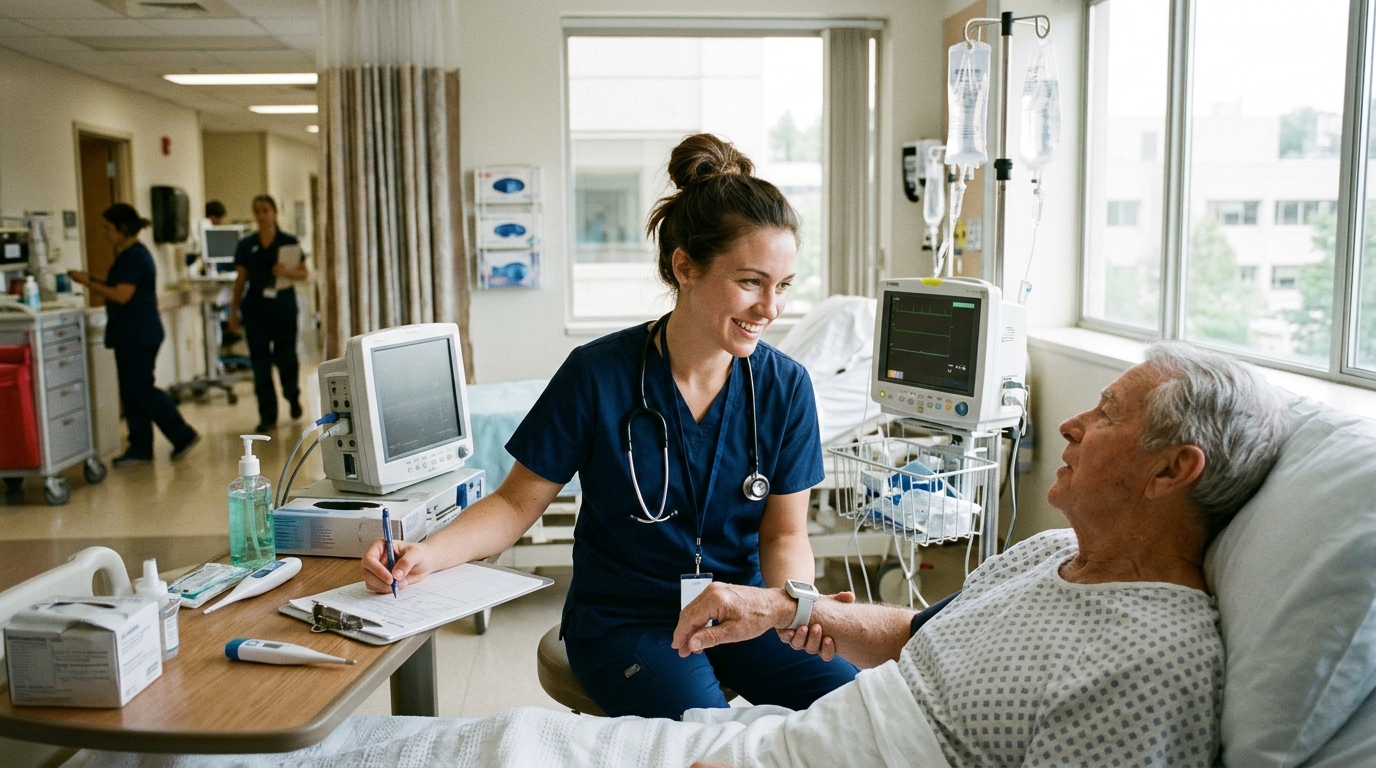
Nursing suits people who can hold a patient's hand and catch a charting error in the same ten minutes. Registered nurses assess patients, record histories and symptoms, administer medicines and treatments, and build care plans (U.S. Bureau of Labor Statistics, 2025) — usually on shifts that cover nights, weekends and holidays, because hospitals and nursing care facilities need round-the-clock coverage (U.S. Bureau of Labor Statistics, 2025).
It is a licensed occupation, not an open door: you need an approved nursing program and a passing score on a qualifying exam before any state will issue a license (U.S. Bureau of Labor Statistics, 2025). This guide walks through the daily work, the traits that help, the ones that don't, and the route in.
What a Registered Nurse Actually Does
A hospital staff nurse usually arrives 15 minutes before the shift for handoff report: the off-going nurse runs through each assigned patient's overnight vital signs, new orders, pain control and anything that changed at 3am. You then pull up the electronic health record — Epic and Cerner are the two you'll most often meet — and check overnight labs and pending orders before you see anyone.
Head-to-toe assessments come next, usually before the 9am medication pass: lung sounds, heart sounds, bowel sounds, skin checks, IV sites, pain scores. Registered nurses assess patients' conditions, record medical histories and symptoms, observe patients and record observations, administer medicines and treatments, and set up or contribute to care plans (U.S. Bureau of Labor Statistics, 2025). Each of those happens several times a shift, not once.
Mid-morning you round with the hospitalist or surgical team, flag the patient whose blood pressure has drifted, and get orders changed. Afternoon is discharge teaching — explaining a new anticoagulant to a patient and their daughter — admissions from the emergency department, dressing changes, and calls to pharmacy about a missing dose.
Contact is nearly constant: 91% of registered nurse respondents reported constant contact with others and 96% reported face-to-face discussions with individuals and teams every day (O*NET OnLine, U.S. Department of Labor, 2026). Documentation is the last thing, and it is rarely finished early.
Signs This Career Might Fit You
- You think in priorities, not lists: when two patients need you at once — one with chest pain, one asking for a blanket — critical-thinking skills decide who you see first, and critical thinking is named as an important quality for registered nurses (U.S. Bureau of Labor Statistics, 2025).
- You can hold your face steady while your pulse rises: stress tolerance and self-control are listed work styles for registered nurses (O*NET OnLine, U.S. Department of Labor, 2026), and a family watching you code their father will read every expression.
- You like explaining things out loud, repeatedly: teaching a newly diagnosed diabetic to draw up insulin, then re-teaching it after discharge, is daily work — 96% of registered nurses reported face-to-face discussions every day (O*NET OnLine, U.S. Department of Labor, 2026).
- Detail matters to you at 3am as much as at 9am: being detail oriented is a named quality (U.S. Bureau of Labor Statistics, 2025) because a decimal point in a pediatric dose calculation is the difference between a treatment and a harm.
- Helping, teaching and advising is the point of the work for you: the interest code for registered nurses is SCI — Social, Conventional, Investigative — where Social means work involving helping, teaching, advising or providing service to others (O*NET OnLine, U.S. Department of Labor, 2026).
- Your body holds up to a long day on your feet: physical stamina is a named quality, and nurses spend a lot of time walking, bending, stretching and standing (U.S. Bureau of Labor Statistics, 2025).
- You want a defined ladder: most registered nurses start as staff nurses and can advance to assistant clinical nurse manager, charge nurse, head nurse, or senior roles such as director of nursing or chief nursing officer (U.S. Bureau of Labor Statistics, 2025).
Signs This Career Might Not Fit You
- You need your nights and holidays: nurses in hospitals and nursing care facilities usually work in shifts for round-the-clock coverage and may work nights, weekends, holidays and on call (U.S. Bureau of Labor Statistics, 2025) — that includes the Thanksgiving your family hosts.
- Physical work wears you down fast: the job involves a lot of walking, bending, stretching and standing, and nurses are vulnerable to back injuries from lifting and moving patients (U.S. Bureau of Labor Statistics, 2025).
- Infection risk would sit badly with you: 61% of registered nurse respondents reported exposure to disease or infections every day (O*NET OnLine, U.S. Department of Labor, 2026), which means isolation gowns, N95 fit testing and respiratory season.
- You want to work mostly alone and uninterrupted: with 91% reporting constant contact with others (O*NET OnLine, U.S. Department of Labor, 2026), a quiet hour to finish charting is the exception.
- You'd rather not spend years in training before you start: registered nurses sit in Job Zone Four, Considerable Preparation Needed, typically requiring a four-year bachelor's degree (O*NET OnLine, U.S. Department of Labor, 2026), and a BSN usually takes four years (U.S. Bureau of Labor Statistics, 2025).
- High-stakes exams rattle you badly: no license, no job — licensure requires graduating an approved program and passing a qualifying exam (U.S. Bureau of Labor Statistics, 2025).
A Day in the Life
A common hospital pattern is three 12-hour shifts a week; clinic and school nursing roles run shorter days. This table reflects a medical-surgical day shift.
| Time block | Typical task | Who you interact with |
|---|---|---|
| 6:45am-7:30am | Handoff report, chart review in the EHR, check overnight labs and new orders | Off-going night nurse, charge nurse |
| 7:30am-9am | Head-to-toe assessments, vital signs, safety checks on IV lines and drips | Patients, families, nursing assistants |
| 9am-10:30am | Medication pass, insulin and pain medication, documenting each administration | Patients, pharmacist by phone |
| 10:30am-12pm | Rounds with the medical team, raising changed symptoms, taking new orders | Hospitalist, resident, physical therapist, case manager |
| 12pm-2pm | Admissions from the emergency department, wound care, blood transfusion monitoring | Emergency department RN, lab, patient |
| 2pm-4pm | Discharge teaching on new medicines, follow-up instructions, second medication pass | Patient, family, case manager |
| 4pm-6pm | Reassessments, responding to call lights and a rapid response, catching up on charting | Patients, rapid response team, charge nurse |
| 6pm-7:30pm | Final vitals, tidying orders, giving handoff report to the night nurse | On-coming night nurse |
How to Get Started
- Test the setting before you commit. Work or volunteer in direct patient care — a Certified Nursing Assistant course usually runs a few weeks to a few months depending on your state's requirements, and it puts you at the bedside doing baths, transfers and vital signs. Do this alongside prerequisite science courses (anatomy, physiology, microbiology), which commonly take two to three semesters.
- Choose one of the three education paths. Registered nurses usually take a bachelor's degree in nursing, an associate's degree in nursing, or a diploma from an approved nursing program (U.S. Bureau of Labor Statistics, 2025). BSN programs typically take four years; diploma programs, usually offered by hospitals or medical centers, typically take two to three years (U.S. Bureau of Labor Statistics, 2025).
- Complete clinical rotations inside the program. You rotate through medical-surgical, pediatrics, obstetrics, psychiatric and community placements. Use them to find the specialty you want — reported job titles include Emergency Department RN, Oncology RN, Operating Room Registered Nurse, Psychiatric RN and School Nurse (O*NET OnLine, U.S. Department of Labor, 2026).
- Apply for licensure and sit the NCLEX-RN. Nurses must hold a license issued by the state in which they work, which requires graduating from an approved program and passing a qualifying exam (U.S. Bureau of Labor Statistics, 2025). The NCLEX-RN is developed by the National Council of State Boards of Nursing and allows up to five hours, with 85 to 150 questions; the 2026 test plan is effective April 1, 2026 through March 31, 2029 (NCSBN test plan information, 2026). Most graduates test within one to three months of finishing, after four to eight weeks of focused review.
- Add the required life support cards. Positions may require CPR, basic life support (BLS) or advanced cardiac life support (ACLS) certification (U.S. Bureau of Labor Statistics, 2025). BLS is typically a one-day course; ACLS usually runs one to two days.
- Apply as a Staff Nurse or new graduate resident. Hospitals employ 59% of registered nurses and ambulatory healthcare services 19% (U.S. Bureau of Labor Statistics, 2025). New graduate residencies commonly last six to twelve months and include a preceptored orientation on a unit.
- Specialize or step up after experience. Nurses may become certified through professional associations in areas such as ambulatory care, gerontology or pediatrics (U.S. Bureau of Labor Statistics, 2025); most certifications require one to two years of practice hours. From staff nurse, the usual next steps are charge nurse or assistant clinical nurse manager (U.S. Bureau of Labor Statistics, 2025).
Frequently asked questions
How long does it take to become a registered nurse?
It depends on the path. A bachelor's degree in nursing typically takes four years, and a diploma program, usually offered by a hospital or medical center, typically takes two to three years (U.S. Bureau of Labor Statistics, 2025). Add time to apply for licensure and pass the qualifying exam after graduation.
Do you need a bachelor's degree to be a nurse?
Not always. Registered nurses usually take one of three paths: a bachelor's degree in nursing, an associate's degree in nursing, or a diploma from an approved program (U.S. Bureau of Labor Statistics, 2025). All three routes require a state license. Some employers and magnet hospitals prefer or require the BSN.
How much do registered nurses get paid?
Pay is usually structured as an hourly base rate plus differentials for nights, weekends and on-call, and varies by state and employer. The U.S. Bureau of Labor Statistics published a median annual wage for registered nurses for May 2025 — check the current BLS Occupational Employment and Wage Statistics figures for your state.
Is nursing a growing field?
Employment of registered nurses is projected to grow 6 percent from 2025 to 2035, faster than the average for all occupations, with about 180,800 openings projected each year on average over the decade (U.S. Bureau of Labor Statistics, 2025). Hiring still varies by state and specialty.
Do all nurses work night shifts?
No, but many do. Nurses in hospitals and nursing care facilities usually work shifts for round-the-clock coverage and may work nights, weekends, holidays and on call (U.S. Bureau of Labor Statistics, 2025). Ambulatory healthcare services, which employ 19% of registered nurses, more often run daytime hours.
Sources
- U.S. Bureau of Labor Statistics — Registered Nurses : Occupational Outlook Handbook (2025)
- O*NET OnLine (U.S. Dept. of Labor) — 29-1141.00 - Registered Nurses (2026)