Nursing Job Search Roadmap: From New Grad to First Offer
What to do in week one, what to send where, and how to follow up — a stage-by-stage plan from NCLEX candidate to signed offer on a unit.
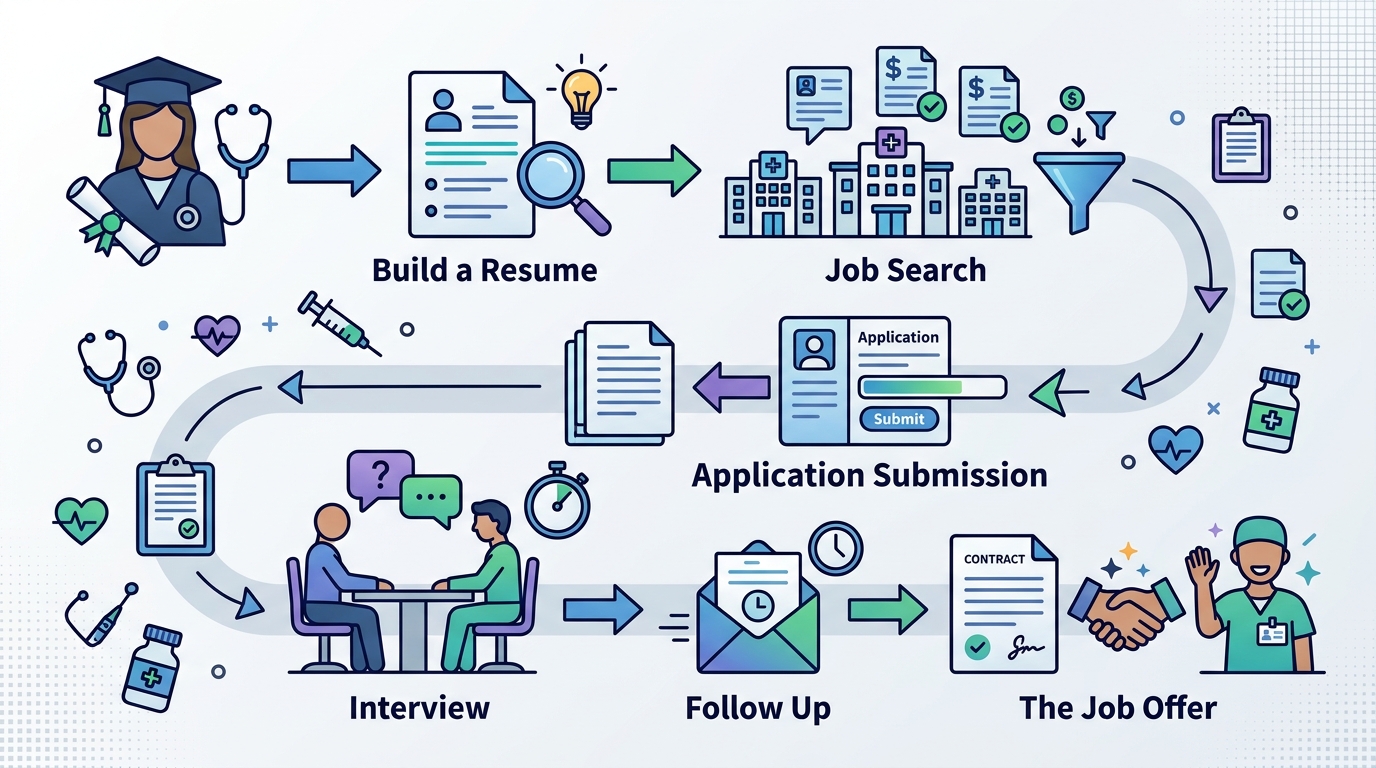
Most new grad nurses land their first role by working two tracks at once: the licensing track (program completion, NCLEX-RN, state board requirements) and the hiring track (nurse residency cohorts, unit postings, interviews). Because many hospital new-graduate residencies run as 12-month programs with fixed cohort start dates (as described on hospital employer career sites), timing your applications matters as much as the strength of your resume.
This roadmap breaks the search into stages with realistic ranges, gives you the exact tactics to use at each step, and shows which content belongs on your resume, in your cover letter, and on your LinkedIn profile.
Typical Timeline to Land the Nursing Job
Stages overlap, and the calendar is set mostly by employer cohort dates and your state board, not by you. Treat these as planning ranges and confirm each one against the posting and your nursing regulatory body.
Weeks 0–4 — application materials and target list. You can apply to many new graduate postings as a graduate nurse before you are licensed; the offer is then contingent on licensure. Milestone: first application submitted.
Week 1 to month 3 — NCLEX-RN. The NCLEX-RN is administered by the National Council of State Boards of Nursing and is the exam graduates must pass to be licensed (Chamberlain University, undated). Unofficial results may be available through Pearson's Quick Results service about two business days after the exam, for roughly $7.95, in participating jurisdictions — but they do not authorize you to practice (Chamberlain University, undated). Official results come from your nursing regulatory body, typically within up to six weeks of the exam (Chamberlain University, undated). If you need to retake, NCSBN policy allows a retake 45 days after your test date, though some regulatory bodies require a longer wait (Kaplan Test Prep, undated). Milestone: pass result in hand.
Weeks 2–8 after applying — first interview. Residency cohorts usually interview in batches after the window closes, so a quiet month does not mean rejection. Milestone: first panel or unit interview.
Weeks 1–4 after interview — offer and pre-boarding. An offer is normally conditional on license verification, a background check where your state requires one (U.S. Bureau of Labor Statistics, 2025), health screening, and current certification — many positions require CPR, basic life support, or advanced cardiac life support (U.S. Bureau of Labor Statistics, 2025).
Months 1–12 on the job — residency. Many hospital new-graduate programs run 12 months, combining clinical orientation with monthly seminar sessions (hospital employer career sites), and some are accredited by the American Nurses Credentialing Center Practice Transition Accreditation Program (Inova Health System, undated).
Step-by-Step Plan for New Grad RNs
1. Fix your license and certification block first. Put a Licenses & Certifications section near the top: RN license or application status with the state and license number once issued, plus BLS, ACLS, or CPR with month and year of expiry. Nursing positions may require CPR, BLS, or ACLS certification (U.S. Bureau of Labor Statistics, 2025), and recruiters screen for it before they read anything else. 2. Rewrite rotations as measurable clinical experience. One line per rotation, each with a number tied to actual nursing duties: - "Completed 180-hour senior practicum on a 32-bed medical-surgical unit; carried a 4-patient assignment independently by week 6 with preceptor oversight." - "Documented assessments, intake and output, and medication administration for up to 5 patients per 12-hour shift in the unit's electronic health record with zero late charting entries." - "Performed 40+ supervised medication passes including 2 blood product administrations, each verified with a second-nurse check." 3. Match the posting's words for the applicant tracking system. Copy the posting's exact clinical nouns into your skills and bullets — telemetry, sepsis screening, wound care, SBAR handoff, Foley insertion, ACLS — using the same spelling the posting uses, including the spelled-out term and the acronym once each ("advanced cardiac life support (ACLS)"). Keep certifications in the body text, not in headers, footers, tables, or columns, and save as FirstLast_RN_Resume.pdf unless the posting asks for .docx. 4. Build a target list of 12–20 employers, not 100 applications. For each, note the unit types you would accept, whether they run a new graduate residency, the application window, and whether the program is ANCC-accredited (Inova Health System, undated). ONET lists reported titles under Registered Nurses, code 29-1141.00, including Staff Nurse, Charge Nurse, Emergency Department RN, Oncology RN, and Operating Room Registered Nurse (ONET OnLine, undated) — search those exact titles, not just "nurse." 5. Apply through the employer's own careers portal. Residency postings often never appear on aggregators. Apply the first week the window opens, and write one cover letter per hospital naming the specific unit and why that patient population. 6. Prepare four STAR stories before the first interview. Expect behavioral questions on patient safety, escalation, and conflict with a preceptor or physician. Anchor each in a named skill or duty: > "Tell me about a time you escalated a concern about a patient." > Situation: On my final medical-surgical practicum rotation, a post-operative patient on my 4-patient assignment had a heart rate rising from 92 to 124 over two sets of vitals, with a temperature of 100.8°F. > Task: I was responsible for the assessment and for deciding whether this met the unit's sepsis screening criteria. > Action: I rechecked vitals, completed a focused assessment, ran the sepsis screen in the chart, and gave my preceptor an SBAR handoff with the trend, the screen result, and my recommendation to notify the provider. > Result: The provider ordered blood cultures and fluids within 20 minutes, and my preceptor used my SBAR as the example in that week's debrief. It taught me to report the trend, not the single number. 7. Ask unit-specific questions, then discuss pay. Ask about nurse-to-patient ratio on nights, preceptor assignment length, and residency seminar structure. Pay for registered nurses is usually a base rate plus shift, weekend, and specialty differentials, with overtime on top; the 2025 median pay for registered nurses was $97,550 per year, or $46.90 per hour (U.S. Bureau of Labor Statistics, 2025). Check state-level wage data on the CareerOneStop occupation profile for Registered Nurses, tied to O*NET code 29-1141.00 (CareerOneStop, undated), before you respond to any number. 8. Negotiate what is negotiable for a new grad. Cohort start date, unit placement, shift, tuition support, and certification reimbursement often move more easily than base rate within a residency cohort. Get the final offer, differentials, and contingencies in writing before you resign from anything.
Resume vs. Cover Letter vs. LinkedIn for Nurses
| Content item | Where it goes | How to handle it | ||
|---|---|---|---|---|
| RN license number, state, status | Resume only | Licenses & Certifications section, line one; licensing requirements beyond program completion and the exam vary by state (U.S. Bureau of Labor Statistics, 2025). | ||
| BLS / ACLS / CPR with expiry dates | Resume, repeated as LinkedIn Licenses & Certifications | Resume carries the expiry month and year; LinkedIn carries the issuing body so recruiter searches hit it. | ||
| Clinical rotation list with hours and bed counts | Resume only | Table-free bullets: unit type, bed count, hours, patient assignment size. Too long for a cover letter. | ||
| Education path and graduation date | Resume, mirrored on LinkedIn | State the path plainly — bachelor's, associate's, or diploma from an approved program, all of which include supervised clinical experience (U.S. Bureau of Labor Statistics, 2025). | ||
| Why this hospital, this unit, this population | Cover letter only | One paragraph naming the unit and one clinical reason, not a mission-statement paraphrase. | ||
| Explanation of a gap, relocation, or pending NCLEX date | Cover letter only | One sentence with the date or state, no apology. | ||
| Headline with target role and credentials | LinkedIn only | "New Graduate RN (BSN) | BLS, ACLS | Seeking medical-surgical residency, [state]" — recruiters search by credential and state. |
| Summary / profile paragraph | LinkedIn, optional on resume | On the resume, replace a generic profile with two measurable practicum lines; on LinkedIn, write three sentences in first person. | ||
| Skills keyword list | Resume skills section and LinkedIn Skills | Resume mirrors the posting's exact terms; LinkedIn uses the broad searchable ones (telemetry, wound care, patient education). | ||
| Preceptor and faculty references | Neither — separate sheet | Prepare FirstLast_RN_References.pdf with three names, titles, units, and phone numbers; send only when asked. |
Follow-Up After the Nursing Interview
- Within 24 hours: send one thank-you email per interviewer, each naming a specific detail from your conversation (the unit's ratio, the residency seminar schedule).
- Within 24 hours: email the recruiter your current BLS or ACLS card and license or NCLEX authorization status as PDF attachments, named FirstLast_BLS.pdf and FirstLast_RN_License.pdf.
- Within 48 hours: notify your three references by email that they may be contacted, with the hospital name, the unit, and the interview date.
- Within 48 hours: write down every clinical question you were asked and your answer, in one document you reuse for the next interview.
- On day 7: if the recruiter gave no decision date, send one short status email asking for the expected timeline for your cohort.
- On day 14: if you have heard nothing, follow up once more and ask to be considered for other units or the next cohort start date.
- Within 3 business days of an offer: confirm in writing the base rate, shift and weekend differentials, start date, unit, and every contingency.
- Within 3 business days of a rejection: email asking what would make you a stronger candidate for the next cohort, and log the date that cohort opens.
Frequently asked questions
Should I apply before I pass the NCLEX-RN?
Yes — many new graduate residency postings accept graduate nurse applicants and make the offer contingent on licensure. Confirm the latest date your employer will accept a license for a given cohort start, and remember that official results come from your nursing regulatory body, typically within up to six weeks of the exam (Chamberlain University, undated).
How many applications should a new grad nurse send?
Depth beats volume, because residency hiring runs on cohort windows rather than rolling vacancies. A focused list of 12–20 employers, each applied to on the first day its window opens with a cover letter naming the specific unit, usually produces more interviews than mass-applying to postings outside your commuting range.
Is a specialty certification worth getting before my first RN job?
Certification through professional associations in areas such as ambulatory care, gerontology, or pediatrics is usually voluntary, though it demonstrates competency and some employers require it (U.S. Bureau of Labor Statistics, 2025). As a new grad, prioritize the life support certifications your postings list, then pursue specialty certification once you have the required practice hours.
Is nursing hiring demand strong enough to be picky about units?
Employment of registered nurses is projected to grow 6 percent from 2025 to 2035, faster than the average for all occupations, with about 180,800 openings projected each year (U.S. Bureau of Labor Statistics, 2025). That volume gives you room to target units, but new graduate cohort seats in one hospital are still limited, so apply to several employers for your preferred specialty rather than one.
What do I do if I fail the NCLEX-RN mid-search?
Tell any employer holding a contingent offer promptly and ask whether you can be moved to a later cohort. NCSBN policy allows a retake 45 days after your test date, though some nursing regulatory bodies require a longer wait (Kaplan Test Prep, undated), so confirm your own board's rule before booking.
Sources
- U.S. Bureau of Labor Statistics — Registered Nurses : Occupational Outlook Handbook (2025)
- Chamberlain University — NCLEX Results Timeline: When and How You'll Know