Dental Hygienist vs Dental Assistant: Comparing Pay, Duties, and Day-to-Day Work
Both work chairside in dentists' offices, but one scales and charts teeth under a state license while the other sterilizes, passes instruments and runs the schedule.
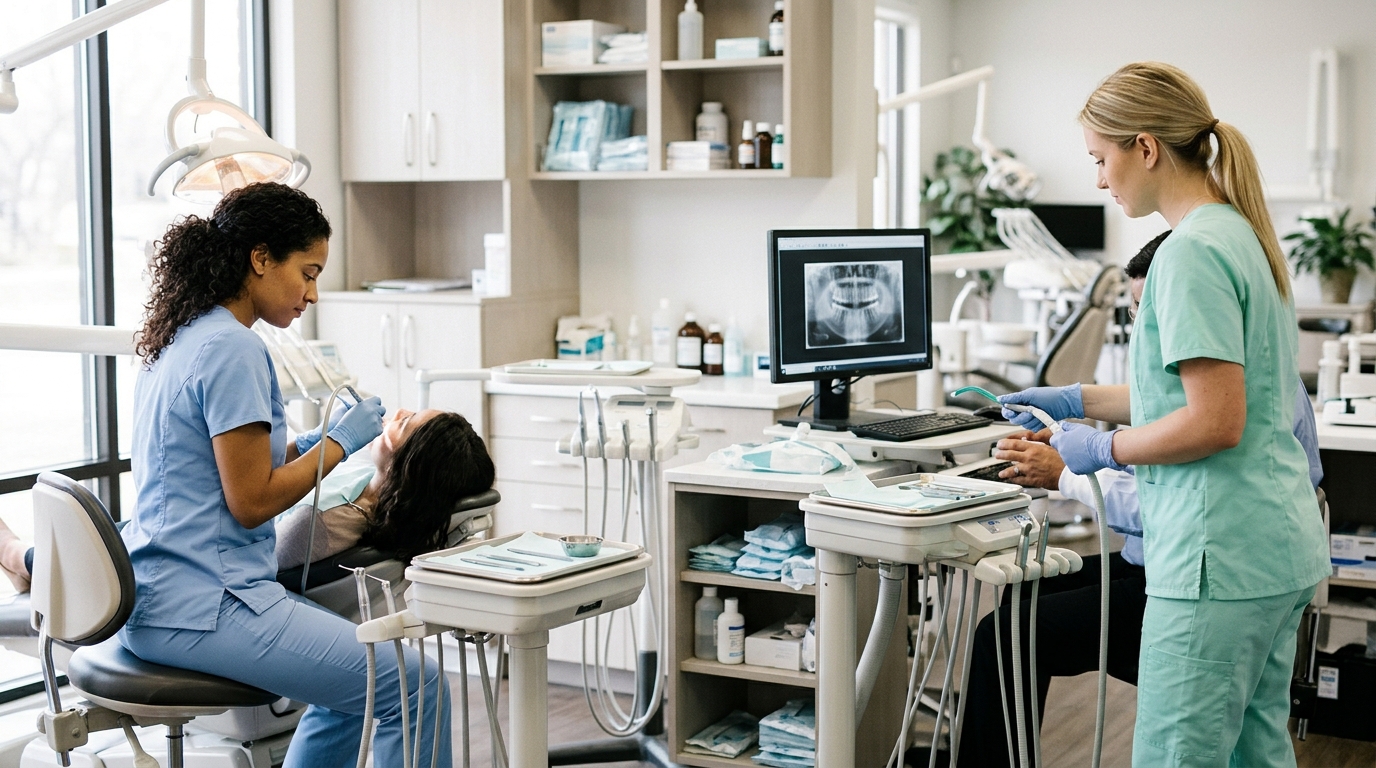
Dental hygienists and dental assistants work in the same treatment rooms, often side by side, but they are separate occupations with separate pay scales and separate training paths. Hygienists earned a median of $94,260 a year in May 2024 (U.S. Bureau of Labor Statistics, 2024), while dental assistants earned a median of $48,070 in May 2025 (U.S. Bureau of Labor Statistics, 2025) — a gap of roughly $46,000.
The trade-off is schooling and licensing. A dental hygiene associate's degree usually takes 3 years and every state requires a license (U.S. Bureau of Labor Statistics, 2024); most dental assisting certificate programs take about 1 year, and many states do not require a license to start (U.S. Bureau of Labor Statistics, 2025).
Side-by-Side Comparison
| Factor | Dental Hygienist | Dental Assistant |
|---|---|---|
| Median pay | $94,260 a year, $45.32 an hour (U.S. Bureau of Labor Statistics, May 2024) | $48,070 a year, $23.11 an hour (U.S. Bureau of Labor Statistics, May 2025) |
| Typical hours | Many work part time; dentists sometimes hire a hygienist for only a few days a week (BLS, 2024) | Most work full time, with some evening and weekend shifts (BLS, 2025) |
| Education required | Associate's degree in dental hygiene, programs usually take 3 years; a license is required in all states, with requirements set state by state (BLS, 2024) | Postsecondary nondegree award; most certificate or diploma programs take about 1 year, and 2-year associate's programs are less common (BLS, 2025) |
| Physical demands | Indoors in one operatory, seated or standing leaning over a reclined patient for most of the shift; repetitive wrist and hand work with hand curettes and an ultrasonic scaler; gloves, mask and protective eyewear worn throughout | Indoors, moving between treatment rooms and the front desk; stands at chairside holding a suction hose, lifts and carries instrument cassettes to the sterilizer, and positions lead aprons and x-ray sensors |
| Primary duties | Examine patients for signs of oral disease such as gingivitis, remove deposits from teeth, provide preventive care and oral hygiene instruction (BLS, 2024) | Prepare patients and work areas, sterilize instruments, hand instruments to the dentist, operate suction hoses, process x-rays and lab tasks under the dentist's direction, keep treatment records, schedule appointments and handle billing (BLS, 2025) |
| Workforce size and outlook | About 221,600 jobs in 2024, projected to grow 7 percent from 2024 to 2034 with roughly 15,300 openings a year (BLS, 2024) | About 388,600 jobs in 2025, projected to grow 7 percent from 2025 to 2035 with roughly 53,000 openings a year (BLS, 2025) |
Day-to-Day Differences
A hygienist works one patient at a time, usually alone in a single operatory. You seat the patient, review the health history, probe and chart pocket depths around each tooth, scale calculus away with an ultrasonic scaler and hand curettes, polish with a prophy angle and paste, apply fluoride varnish, then coach the patient through brushing and flossing changes. You also examine for signs of oral disease such as gingivitis and flag findings for the dentist before the exam (U.S. Bureau of Labor Statistics, 2024).
An assistant moves between rooms and the front of the office all day. You prepare the operatory and the patient before a procedure, pass instruments to the dentist, hold the suction hose to keep the field dry, then strip the room down and run instruments through the ultrasonic bath and autoclave. You take and process x-rays and handle lab tasks under the dentist's direction where your state permits it, update treatment records, book appointments and process billing (U.S. Bureau of Labor Statistics, 2025).
The practical contrast: a hygienist's hours are self-directed and repetitive, built around one procedure done well many times over; an assistant's hours are interrupted, shared with the dentist, and split between clinical and administrative work.
Who Each Job Fits Best
Dental hygienist
- You are willing to spend about 3 years in an associate's degree program and sit for state licensure before you can work at all (U.S. Bureau of Labor Statistics, 2024).
- You prefer working alone with one patient rather than reacting to a dentist's requests minute by minute.
- You can tolerate repetitive hand and wrist work — hours of scaling with curettes and an ultrasonic scaler while leaning over a reclined chair.
- A part-time or two-or-three-day schedule suits you, since dentists sometimes hire hygienists for only a few days a week (U.S. Bureau of Labor Statistics, 2024).
Dental assistant
- You want to start earning within about a year, since most assisting programs lead to a certificate or diploma in that time (U.S. Bureau of Labor Statistics, 2025).
- You like switching tasks: passing instruments one hour, loading the autoclave the next, then handling billing at the front desk (U.S. Bureau of Labor Statistics, 2025).
- You want full-time hours, and can take some evening or weekend shifts (U.S. Bureau of Labor Statistics, 2025).
- You are comfortable testing the field before committing to a 3-year hygiene program, and may later use chairside experience as a reason to apply.
Pay and Advancement
| Measure | Dental Hygienist | Dental Assistant |
|---|---|---|
| Entry pay | New licensees typically start below the national median of $94,260 (U.S. Bureau of Labor Statistics, May 2024), and weekly earnings depend on how many days the practice books, since part-time work is common (BLS, 2024) | The lowest 10 percent earned less than $37,130 (U.S. Bureau of Labor Statistics, May 2025) |
| Median pay | $94,260 a year, $45.32 an hour (U.S. Bureau of Labor Statistics, May 2024); reported as $98,100 a year, $47.16 an hour for May 2025 (medicalaid.org, 2025) | $48,070 a year, $23.11 an hour (U.S. Bureau of Labor Statistics, May 2025) |
| Top earners | Top 10 percent made $126,050 or more, per BLS May 2025 data (open-exam-prep.com, 2025) | The highest 10 percent earned more than $62,250 (U.S. Bureau of Labor Statistics, May 2025) |
| Typical path to the next role | Add state-authorized expanded functions where your state permits them, then move toward public health, education or clinical roles that generally call for further study beyond the entry-level associate's degree (U.S. Bureau of Labor Statistics, 2024) | Earn licensing, registration or certification for expanded duties such as coronal polishing or radiography, holding current CPR certification where certification is required (U.S. Bureau of Labor Statistics, 2025); some assistants then enter a 3-year dental hygiene associate's program (BLS, 2024) |
| Where to check current rates | BLS Occupational Outlook Handbook and state wage data for dental hygienists | BLS Occupational Outlook Handbook and state wage data for dental assistants |
Pay structure in both roles is usually hourly, and hygienists in particular may be paid by the day or half-day in practices that book them part time (U.S. Bureau of Labor Statistics, 2024). Rates differ by state and by employer, so check current state-level figures before you decide.
Frequently asked questions
Can I move from dental assistant to dental hygienist without starting over?
Chairside experience helps you know the instruments and the workflow, but it does not replace the degree. Hygienists need an associate's degree in dental hygiene that usually takes 3 years, plus a license in every state (U.S. Bureau of Labor Statistics, 2024), while assisting programs typically run about 1 year and lead to a certificate (U.S. Bureau of Labor Statistics, 2025). Expect to complete the full hygiene program, with any transfer credit decided by the school.
Why do hygienists earn so much more per hour?
The gap tracks the credential and the scope of practice: $45.32 an hour at the median for hygienists (U.S. Bureau of Labor Statistics, May 2024) against $23.11 for assistants (U.S. Bureau of Labor Statistics, May 2025). Hygienists hold a state license and perform preventive treatment and oral disease screening themselves, while assistants carry out x-rays and lab tasks under the dentist's direction (BLS, 2025). Note that many hygienists work part time, so annual take-home can be lower than the hourly rate suggests (BLS, 2024).
Which job is easier to get hired into?
There are far more assisting positions: about 388,600 jobs in 2025 with roughly 53,000 openings projected each year (U.S. Bureau of Labor Statistics, 2025), compared with about 221,600 hygienist jobs and roughly 15,300 annual openings (U.S. Bureau of Labor Statistics, 2024). Both occupations are projected to grow 7 percent over their respective ten-year periods. Nobody can promise you a job in either, but the shorter program and larger opening count make assisting the faster route in.
Do both roles need a license?
All states license dental hygienists, with requirements set state by state (U.S. Bureau of Labor Statistics, 2024). States typically do not require a license for entry-level dental assistants, though some require licensing, registration or certification to enter, advance or perform expanded duties such as coronal polishing or radiography, and certification applicants must hold current CPR certification (U.S. Bureau of Labor Statistics, 2025). Check your own state dental board before enrolling anywhere.
Sources
- U.S. Bureau of Labor Statistics — Dental Assistants : Occupational Outlook Handbook (2025)
- U.S. Bureau of Labor Statistics — Dental Hygienists : Occupational Outlook Handbook (2024)