Electrician or HVAC Technician: Comparing Training, Duties, and Day-to-Day Work
Both trades pull wire, test circuits and crawl through tight spaces, but licensing routes, seasonal pressure and injury risk pull them apart.
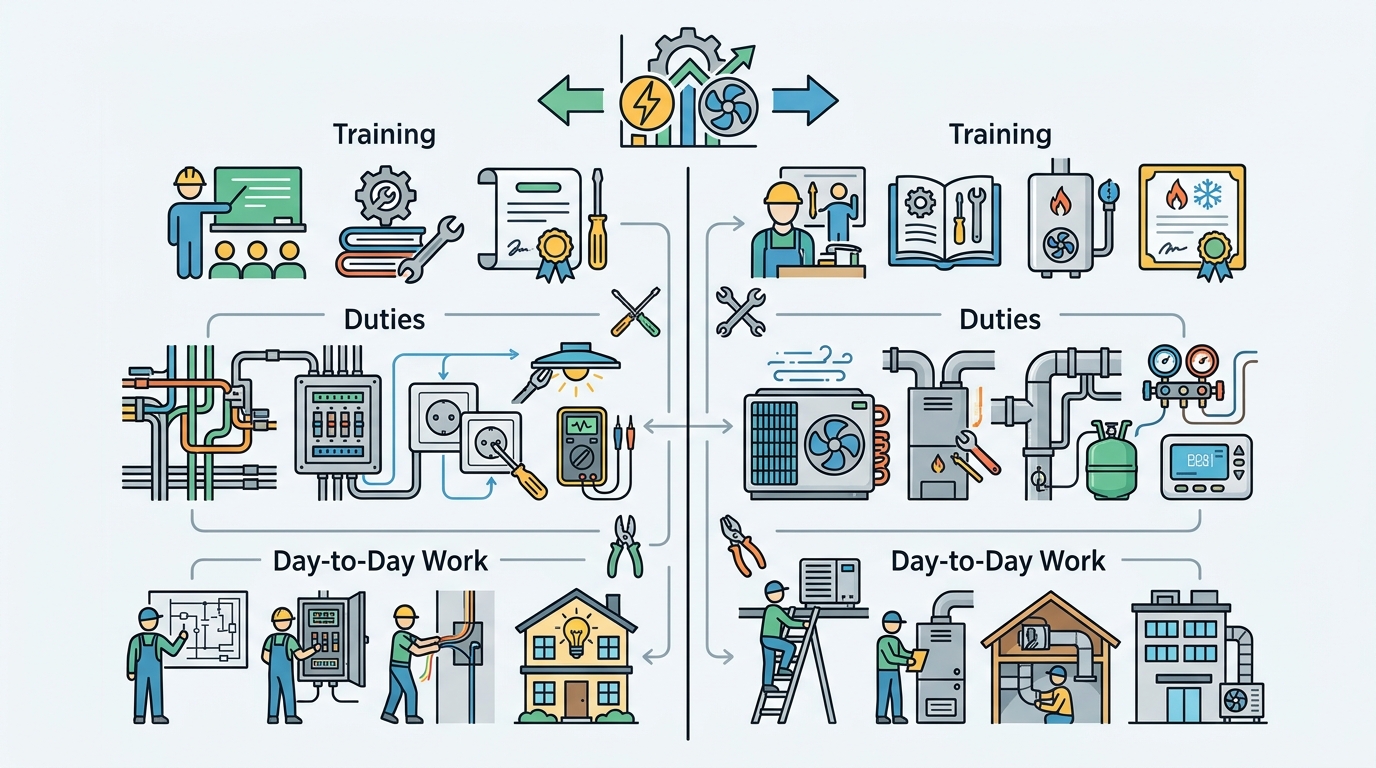
Electricians and HVAC technicians overlap more than most trades: both install electrical components, both read drawings, and both spend the day on their feet with hand and power tools. The split comes in what you are responsible for — electricians own the wiring, lighting and power systems of a building, while HVAC technicians own the heating, cooling and refrigeration equipment, including the refrigerant inside it (U.S. Bureau of Labor Statistics, 2025).
The training routes differ too. Electricians usually enter through a paid apprenticeship and a state licensing exam, while HVAC technicians more often enter through a postsecondary program plus federal refrigerant certification.
Side-by-Side Comparison
| Factor | Electrician | HVAC Technician |
|---|---|---|
| Median pay | A median annual wage for electricians is published each year by the U.S. Bureau of Labor Statistics (2025); look it up in the Occupational Outlook Handbook, and check your state page, since licensed rates are set locally. | A median annual wage for heating, air conditioning, and refrigeration mechanics and installers is published by the U.S. Bureau of Labor Statistics (2025); the same Handbook entry lists state and metro figures. |
| Typical hours | Most electricians work full time, roughly 40 hours a week, with evening and weekend work on shutdowns and new construction schedules (U.S. Bureau of Labor Statistics, 2025). | Most HVAC technicians work full time, roughly 40 hours a week, plus on-call rotations and overtime during peak heating and cooling seasons (U.S. Bureau of Labor Statistics, 2025). |
| Education required | High school diploma or equivalent, then a paid apprenticeship combining classroom instruction with on-the-job training; most states require passing a licensing test based partly on the National Electrical Code (U.S. Bureau of Labor Statistics, 2025). | Postsecondary nondegree award from a trade school or community college program is the typical entry route; some technicians train through an apprenticeship instead, and nearly all need EPA Section 608 certification to handle refrigerant (U.S. Bureau of Labor Statistics, 2025). |
| Physical demands | Stand, kneel and crouch for most of the shift; work in cramped ceilings and crawl spaces and at heights on ladders and lifts, indoors and outdoors (U.S. Bureau of Labor Statistics, 2025). | Work indoors in mechanical rooms and outdoors at condensing units in all weather; burns from brazing and hot components and muscle strains from lifting equipment are common, and HVACR has one of the highest injury and illness rates of all occupations (U.S. Bureau of Labor Statistics, 2025). |
| Primary duties | Read blueprints, install and maintain wiring and lighting systems, inspect electrical components such as circuit breakers and transformers, and repair or replace wiring using hand and power tools (U.S. Bureau of Labor Statistics, 2025). | Install, maintain and repair heating, ventilation, cooling and refrigeration systems, install electrical components and wiring, test systems for correct operation, and discuss malfunctions with customers (U.S. Bureau of Labor Statistics, 2025). |
Day-to-Day Differences
An electrician's hours tend to follow a building's construction or maintenance plan. You unroll drawings and mark device heights, bend and run conduit, pull wire with fish tape, terminate devices and panels, and then test circuits with a multimeter and voltage tester before energizing. On service calls you trace a dead circuit back to a loose connection or a failed breaker, then repair or replace the wiring with hand and power tools (U.S. Bureau of Labor Statistics, 2025). Much of the day is spent kneeling, standing and working overhead in ceilings or on lifts.
An HVAC technician's day is driven by equipment faults and the calendar. You pull a manifold gauge set onto a system to read pressures, recover refrigerant with a recovery machine before opening a sealed circuit, braze line sets, evacuate with a vacuum pump and micron gauge, and replace capacitors, contactors or compressors. You also wire and test the electrical components that control that equipment, and you explain to the customer what failed and what it will cost (U.S. Bureau of Labor Statistics, 2025). In July and January that may mean on-call evenings and weekends; shoulder seasons shift toward scheduled maintenance and filter and coil cleaning.
Who Each Job Fits Best
Electrician suits you if:
- You want a paid apprenticeship route rather than tuition up front, since classroom instruction is combined with on-the-job training (U.S. Bureau of Labor Statistics, 2025).
- You can study for and pass a state licensing exam built partly on the National Electrical Code, then keep up with code cycles.
- You are comfortable reading blueprints and laying out an install from paper before any wire is pulled.
- You do not mind cramped ceilings, crawl spaces and work at height on ladders and lifts.
HVAC technician suits you if:
- You want to start work sooner through a postsecondary program and EPA Section 608 refrigerant certification rather than a multi-year apprenticeship.
- You like diagnostic work — testing pressures, airflow and electrical controls to find why one system is failing.
- You can handle customer conversations, since explaining malfunctions and repair options to homeowners and facility managers is part of the job (U.S. Bureau of Labor Statistics, 2025).
- You accept on-call rotations and overtime in peak heating and cooling seasons, plus brazing burns and lifting strain as real hazards (U.S. Bureau of Labor Statistics, 2025).
Pay and Advancement
| Row | Electrician | HVAC Technician |
|---|---|---|
| Entry pay | Apprentices are paid a percentage of the journey-worker rate that steps up as hours and classroom credits are completed; check the sponsoring program's wage schedule (U.S. Bureau of Labor Statistics, 2025). | Helpers and new graduates typically start on an hourly rate below the technician rate and ride with a licensed technician until they can run calls alone; check employer postings in your metro (U.S. Bureau of Labor Statistics, 2025). |
| Median pay | Median annual wage for electricians is published in the Occupational Outlook Handbook (U.S. Bureau of Labor Statistics, 2025), with state and metro breakdowns in the same dataset. | Median annual wage for heating, air conditioning, and refrigeration mechanics and installers is published in the Occupational Outlook Handbook (U.S. Bureau of Labor Statistics, 2025). |
| Typical path to the next role | Complete apprenticeship hours, pass the state journeyman exam, then qualify for a master electrician license and move into foreman, estimator or contractor work; requirements are set state by state (U.S. Bureau of Labor Statistics, 2025). | Add EPA Section 608 certification, then specialize in commercial refrigeration or controls, move to lead technician or service manager, or start a contracting business; licensing rules differ by state and municipality (U.S. Bureau of Labor Statistics, 2025). |
| Outlook | Employment growth and annual job openings for electricians are projected for 2025-2035 (U.S. Bureau of Labor Statistics, 2025); construction is a large share of employment. | Employment growth and annual job openings for HVACR mechanics and installers are projected for 2025-2035 (U.S. Bureau of Labor Statistics, 2025); plumbing, heating and air-conditioning contractors employ the largest share. |
Frequently asked questions
Can an electrician do HVAC work, or an HVAC technician do electrical work?
There is real overlap: HVAC technicians install electrical components and wiring as part of equipment installation, and electricians often land the circuits and disconnects that feed that equipment (U.S. Bureau of Labor Statistics, 2025). But the legal boundaries differ — most states license electricians by exam, while EPA Section 608 certification governs refrigerant handling. Crossing either line without the right credential is a licensing problem, not a skills problem, so check your state board before taking on the other trade's scope.
Which one gets you working faster?
HVAC generally has the shorter runway, because the typical entry route is a postsecondary nondegree program plus EPA Section 608 certification, whereas electricians usually complete a multi-year apprenticeship before sitting a state licensing exam (U.S. Bureau of Labor Statistics, 2025). The trade-off is that an electrical apprenticeship pays you while you learn, on a wage scale that steps up with completed hours. If tuition and time out of work are the constraint, compare the apprenticeship wage schedule against the program cost.
Which job is harder on your body?
Both involve standing, kneeling and lifting all day, but HVACR mechanics and installers have one of the highest rates of injuries and illnesses of all occupations, with burns from brazing and hot components and muscle strains from moving equipment (U.S. Bureau of Labor Statistics, 2025). Electricians face cramped spaces, repeated kneeling and work at height on ladders and lifts, plus live-circuit risk. Expect outdoor work in both — at rooftop units for HVAC, and on service and construction sites for electricians.
Where should I check current pay for my area?
Use the U.S. Bureau of Labor Statistics Occupational Outlook Handbook entries for electricians and for heating, air conditioning, and refrigeration mechanics and installers (2025), which list median wages and state-level figures. Then compare that against local job postings and, for union electrical work, the local collective bargaining wage schedule. Pay for both trades is usually hourly, with overtime and on-call premiums that matter most in HVAC during peak seasons.
Sources
- U.S. Bureau of Labor Statistics — Electricians : Occupational Outlook Handbook (2025)
- U.S. Bureau of Labor Statistics — Heating, Air Conditioning, and Refrigeration Mechanics and Installers : Occupational Outlook Handbook (2025)