How to Become a Dental Hygienist
Scaling teeth, taking x-rays and charting gum health chairside — plus the accredited degree, national exam and state licence you need before you start.
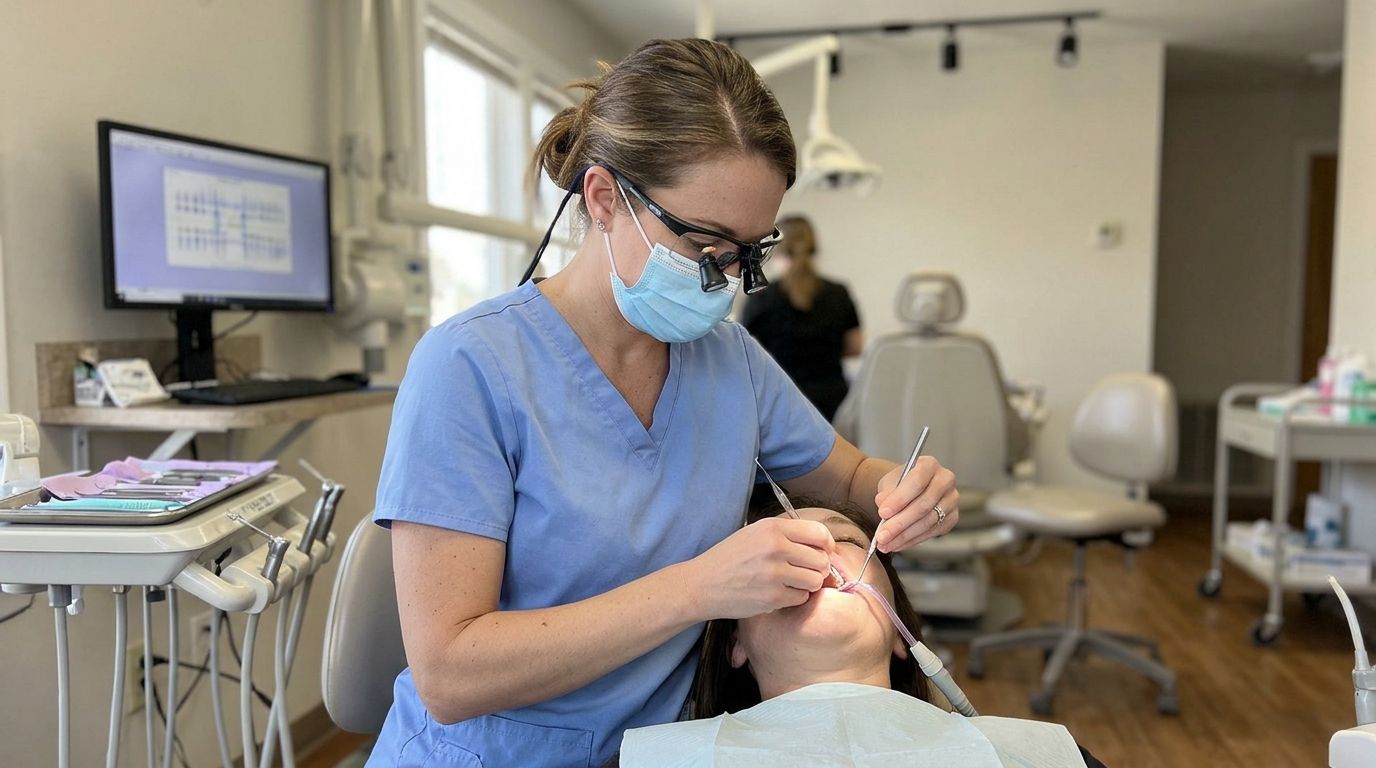
Becoming a dental hygienist means completing a dental hygiene program accredited by the Commission on Dental Accreditation, then passing written and clinical examinations and applying to your state board for a licence. An associate's degree is the typical entry-level education for the job (U.S. Bureau of Labor Statistics, 2025), and every state requires hygienists to be licensed, though the exact requirements vary by state (U.S. Bureau of Labor Statistics, 2025).
No prior work experience in a related occupation is needed to enter the field (U.S. Bureau of Labor Statistics, 2025), so the degree program is the main gate. Nearly all hygienists work in dentists' offices, and many work part time (U.S. Bureau of Labor Statistics, 2025).
What the Job Involves Day to Day
You work chairside in a treatment room, usually seated on a saddle stool and leaning over a reclined patient, in gloves, a mask and protective eyewear, with the whine of an ultrasonic scaler running for much of the day.
A typical appointment list has you:
- Record and review the patient's medical history, then update allergies and medications in the electronic dental record (O*NET OnLine, 2025).
- Feel and visually examine the gums for sores and signs of disease, and probe pockets with a periodontal probe to measure recession and gum disease (O*NET OnLine, 2025).
- Remove tartar, stains and plaque with hand scalers, curettes and an ultrasonic scaler, then polish with a prophy angle and paste (U.S. Bureau of Labor Statistics, 2025).
- Take and develop dental x-rays, positioning digital sensors and placing a lead apron (U.S. Bureau of Labor Statistics, 2025).
- Apply fluoride varnish and pit-and-fissure sealants (U.S. Bureau of Labor Statistics, 2025).
- Report findings to the dentist, document treatment in the chart, and demonstrate brushing and flossing technique to the patient (U.S. Bureau of Labor Statistics, 2025).
Nearly all hygienists do this in dentists' offices, and many work part time, often splitting a week across two practices (U.S. Bureau of Labor Statistics, 2025).
Path to Becoming a Dental Hygienist
- Finish high school and clear the prerequisites. Most programs ask for biology, chemistry and algebra, plus college-level anatomy and physiology before you enter. Expect a semester or two of prerequisite coursework if you do not already have them; the list varies by college.
- Pick a program accredited by the Commission on Dental Accreditation (CODA). In most states, licensure requires a degree from an accredited dental hygiene program (U.S. Bureau of Labor Statistics, 2025). CODA publishes which programs hold accreditation (Commission on Dental Accreditation, undated) — verify status before you pay a deposit.
- Apply and enrol. Programs are competitive and often admit one cohort a year, so build your application around the published deadline. An associate's degree is the typical entry-level education (U.S. Bureau of Labor Statistics, 2025).
- Complete didactic and clinical coursework. You will log supervised patient hours in a school clinic, scaling, probing and taking radiographs on real patients. Confirm the program's published length and clinic hour requirement with the school.
- Obtain CPR certification. Many dental hygienist jobs require cardiopulmonary resuscitation certification (U.S. Bureau of Labor Statistics, 2025); a provider-level course is usually a single day and must be kept current.
- Sit the National Board Dental Hygiene Examination (NBDHE). Your program director determines your eligibility, or you submit proof of graduation from an accredited program (Joint Commission on National Dental Examinations, undated). It runs year round at Pearson VUE test centers in the US and Canada and is accepted in all US licensing jurisdictions (Joint Commission on National Dental Examinations, undated). Check the current fee on the examination's own site.
- Pass the clinical examination your state accepts. Most states require written and clinical examinations for licensure (U.S. Bureau of Labor Statistics, 2025). Which clinical exam counts is a state-by-state decision — ask your state dental board.
- Apply to the state board for your licence, then apply for jobs. Expect to submit transcripts, exam results, a background check and a fee. Target dentists' offices first: that is the top employing industry for the occupation (O*NET OnLine, 2025).
Timeline at a Glance
| Stage | Milestone |
|---|---|
| Before you apply | Prerequisite science courses finished; CODA accreditation of your shortlisted programs checked |
| Application cycle | Application submitted to one annual cohort intake; transcripts and any entrance test results sent |
| Early program | Head and neck anatomy, radiography and instrumentation coursework; first supervised scaling on classmates and manikins |
| Mid program | Supervised patient clinic hours logged; radiographs taken and mounted; periodontal charting assessed |
| Final term | Graduation requirements cleared; CPR certification current; NBDHE eligibility confirmed by your program director |
| Graduation to licence | NBDHE sat at a Pearson VUE test center, state-accepted clinical exam passed, licence application filed with the state board |
| First role | Interviews at dentists' offices; many first jobs are part time (U.S. Bureau of Labor Statistics, 2025) |
Durations differ by college and by state board processing time, so treat each program's published calendar as the authority.
Requirements Checklist
- Diploma or degree awarded by a dental hygiene program accredited by the Commission on Dental Accreditation.
- Official transcripts ordered and sent to the state dental board.
- NBDHE eligibility confirmed by your program director, or proof of graduation submitted (Joint Commission on National Dental Examinations, undated).
- National Board Dental Hygiene Examination passed.
- The clinical examination accepted by your state passed (U.S. Bureau of Labor Statistics, 2025).
- Current CPR certification card in hand (U.S. Bureau of Labor Statistics, 2025).
- State licence issued before you treat any patient — all states require licensure (U.S. Bureau of Labor Statistics, 2025).
- Supervised clinical patient hours logged and signed off as required by your program.
No prior work experience in a related occupation is listed as an entry requirement (U.S. Bureau of Labor Statistics, 2025), so a thin résumé is not a barrier.
Education and Cost Comparison
| Route | Typical length | Cost | Typical starting pay |
|---|---|---|---|
| Associate's degree in dental hygiene (CODA-accredited) | The typical entry-level education for the occupation (U.S. Bureau of Labor Statistics, 2025); confirm semesters with the college | Varies by state residency and whether the college is public or private — request the program's published cost sheet | Check the median annual wage for dental hygienists in the BLS Occupational Outlook Handbook (U.S. Bureau of Labor Statistics, May 2025), then your state's figure |
| Bachelor's degree in dental hygiene (CODA-accredited) | Longer than the associate's route; set by the university | Usually higher total tuition than a community college associate's program; compare published per-credit rates | Same licensed entry roles in dentists' offices; the bachelor's is more often sought for teaching, public health and research posts |
Both routes must be CODA-accredited to satisfy licensure in most states (U.S. Bureau of Labor Statistics, 2025; Commission on Dental Accreditation, undated). The practical contrast is time versus options: the associate's route gets you to the same state licence and the same chairside job sooner, while the extra years of a bachelor's open non-clinical paths. For pay and for projected employment growth over 2025–35, read the figures directly from the BLS Occupational Outlook Handbook rather than from job adverts.
Frequently asked questions
Do I need to work as a dental assistant first?
No — the U.S. Bureau of Labor Statistics (2025) lists no work experience in a related occupation as an entry requirement for dental hygienists. Your accredited program and state licence do the work instead. Some people do assist first to confirm they like clinical chairside work, but it is a choice, not a prerequisite.
Can I sit the national board exam before I graduate?
Your eligibility has to be determined by your dental hygiene program director, or you must submit proof of graduation from an accredited education program (Joint Commission on National Dental Examinations, undated). That means some candidates are cleared to test in their final term and others only after graduating. The NBDHE is available year round at Pearson VUE test centers in the US and Canada, so scheduling is flexible once you are eligible.
Will my licence work if I move to another state?
Every state requires a licence, but requirements vary by state (U.S. Bureau of Labor Statistics, 2025), so a move usually means an application to the new state board rather than an automatic transfer. The NBDHE result travels well — it is accepted at all US licensing jurisdictions (Joint Commission on National Dental Examinations, undated). Contact the board in the state you are moving to for its current rules on clinical exams and endorsement.
Is dental hygiene mostly part-time work?
Many dental hygienists work part time, and nearly all work in dentists' offices (U.S. Bureau of Labor Statistics, 2025). It is common to combine two or three days at one practice with days at another to build a full week. Ask in interviews how many days the practice schedules hygiene appointments, since that sets your hours.
How do I find out what the job pays where I live?
Look up the dental hygienist page in the BLS Occupational Outlook Handbook for the median annual wage (U.S. Bureau of Labor Statistics, May 2025), then check the state and metropolitan wage data behind it, because pay differs sharply by location and employer. Pay may be hourly, daily or salaried depending on the practice, and part-time schedules change the annual total. Confirm the structure, not just the rate, before accepting an offer.
Sources
- U.S. Bureau of Labor Statistics — Dental Hygienists : Occupational Outlook Handbook (2025-05)
- Joint Commission on National Dental Examinations (ADA) — National Board Dental Hygiene Examination (NBDHE)