How to Become a Medical Coder: Step-by-Step Guide
A practical look at the credential routes, exam steps and software employers expect, plus what to confirm with AAPC, AHIMA and your own state first.
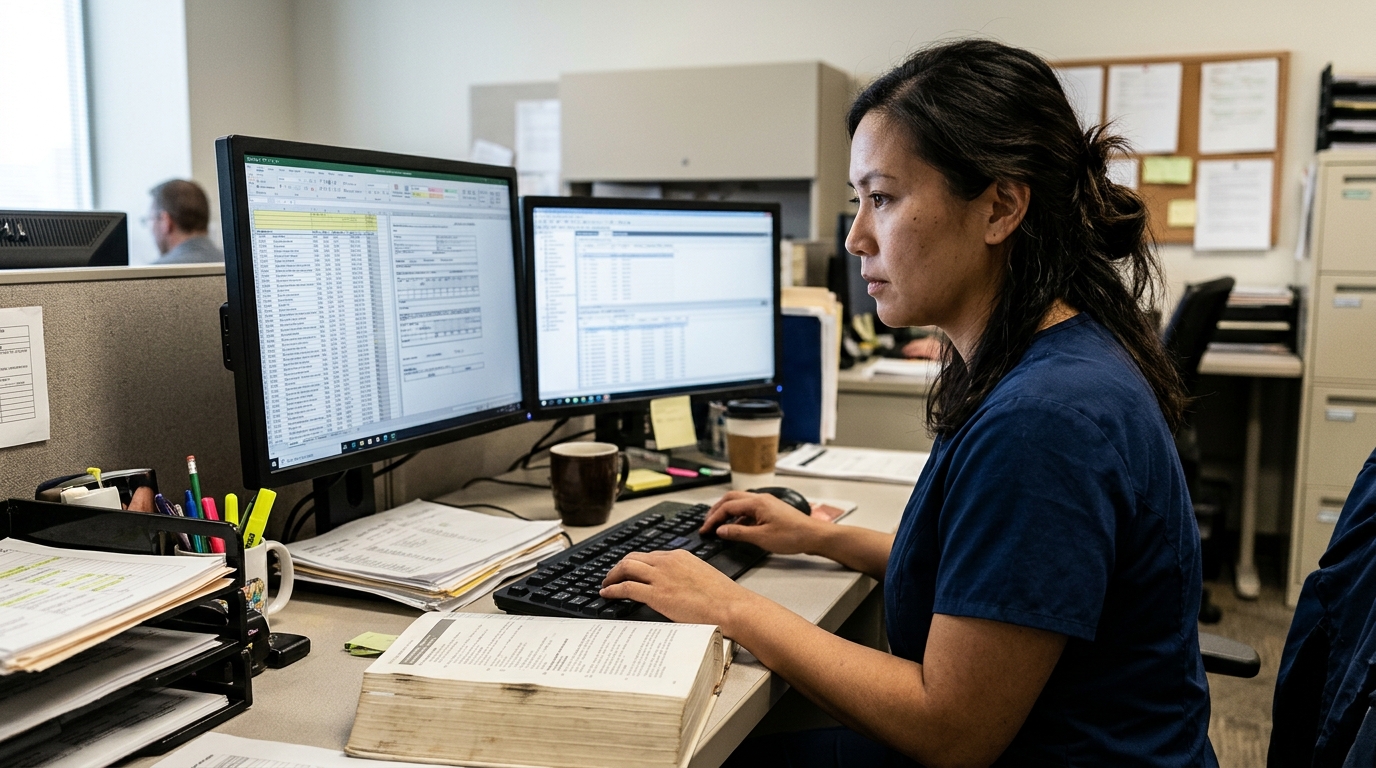
Medical coding means reading clinical documentation and translating it into ICD-10-CM, CPT and HCPCS Level II codes so that care can be billed and recorded. Most people enter through a coding training program followed by an entry-level credential — usually the Certified Professional Coder (CPC) from AAPC or the Certified Coding Associate (CCA) from AHIMA — rather than through a four-year degree.
The U.S. Bureau of Labor Statistics groups coders under Medical Records Specialists (SOC 29-2072), and ONET's description for 29-2072.00 explicitly includes medical coders, with reported job titles such as Coder, Medical Coder and Health Information Technician (ONET OnLine, 2026). That is the occupation code to use when you check pay, outlook and local openings.
What the Job Actually Involves
Most of the work is documentation review and code assignment at a computer. The U.S. Bureau of Labor Statistics notes that medical records specialists typically spend many hours at a computer and that most work full time (U.S. Bureau of Labor Statistics, 2025).
A representative day in an outpatient or physician-practice coding role:
- Open your assigned work queue in the electronic health record. ONET lists Epic Systems among the in-demand technology skills for this occupation, along with Microsoft Excel, Microsoft Word, Microsoft Outlook and Microsoft Office software (ONET OnLine, undated).
- Read the encounter note, operative report or discharge summary and identify the diagnoses and procedures that are actually documented.
- Assign ICD-10-CM diagnosis codes, CPT and HCPCS Level II procedure codes, plus modifiers, using an encoder or current-year code books.
- Check code pairings against payer edits and medical-necessity rules, and resolve anything the claim scrubber flags.
- Write a physician query when documentation is ambiguous or incomplete, then track the response.
- Rework denied or returned claims, often alongside billing staff.
- Log productivity — charts per hour and accuracy rate — in a spreadsheet or the department's tracking tool.
Inpatient coders work from longer records and spend more time sequencing a principal diagnosis and assigning DRGs. Risk-adjustment and auditing roles involve reviewing charts already coded by someone else.
Settings and schedule: ONET identifies health care and social assistance as the industry where this occupation is concentrated (ONET OnLine, undated), which in practice means hospitals, physician groups, surgery centers, and the billing companies and payers that serve them. Schedules are usually standard business-hours full time. Remote and hybrid coding is common but is set by the employer, not by any national rule, and many employers require a period onsite first. BLS describes on-the-job training as part of attaining competency in this occupation (U.S. Bureau of Labor Statistics, 2025), so expect a supervised ramp-up with audits of your early charts.
Step-by-Step Path to Entry
Steps 1 and 2 must come first. Step 3 happens at the same time as step 4 if you choose the AAPC route. Step 5 can begin before you are credentialed if you can find a coding-adjacent job.
1. Check the occupation data for your area. Look up SOC 29-2072 in the BLS Occupational Outlook Handbook for the current median annual pay figure, the typical entry-level education, the related work experience required, and the projected employment growth for 2025-2035 (U.S. Bureau of Labor Statistics, 2025). Pay and openings vary by state and metro area, so use the BLS state and metro tables rather than a national number. Time: an afternoon. Cost: none. 2. Cover the prerequisite subject matter. AHIMA identifies the knowledge areas expected before sitting its entry exam: anatomy and physiology, medical terminology, and basic ICD diagnostic and procedural coding plus CPT coding (AHIMA, undated). You can cover these in a community college course sequence or inside a coding program. 3. Complete a coding training program. Options include an AHIMA-approved coding program (PCAP), an AAPC course, a community college certificate, or an associate degree in health information technology. Program length and tuition vary widely by school and state — get the published tuition figure and the program length in months in writing from the school before enrolling. 4. Join AAPC if you are taking the CPC route. An active AAPC membership is mandatory to register for the CPC exam (CCI Training Center, undated). Check AAPC's current membership and exam fee schedule for the dollar amounts; they change, and student rates differ from standard rates. 5. Register for and pass an entry credential exam. - CPC (AAPC): review AAPC's published exam format, content areas, passing score and exam fee before you book (CCI Training Center, undated). - CCA (AHIMA): confirm AHIMA's stated eligibility requirement, exam format and current exam cost on AHIMA's certification pages (AHIMA, undated). AHIMA recommends, but does not require, six months of coding experience or completion of an AHIMA-approved coding program before sitting the CCA (AHIMA, undated). 6. Remove the CPC-A apprentice designation, if you hold one. AAPC allows removal through one of four pathways: two years of employment, one year of employment plus education, Practicode plus an 80-hour coding course, or AAPC's Job-Ready Program (AAPC, undated). Decide which you are aiming for before you finish your exam, because the Practicode and course route can run in parallel with job hunting. 7. Apply using the occupation's real job titles. ONET's reported titles for 29-2072.00 include Coder, Medical Coder, Health Information Technician and RHIT (ONET OnLine, 2026). Searching only "medical coder" hides openings. 8. Keep the credential active. CPC holders must meet AAPC's continuing education requirement (CareerStep, undated) and maintain membership (CCI Training Center, undated). Build CEU tracking into your first year rather than your renewal month.
Education and Certification Options Compared
Costs and lengths differ by provider and state; confirm both figures with the issuing body or school before enrolling.
| Path | Credential earned | Typical duration | Typical cost | Satisfies state licensing? |
|---|---|---|---|---|
| AAPC coding course plus CPC exam | Certified Professional Coder (CPC), AAPC | Course length set by AAPC; exam booked separately | Membership plus exam fee as published by AAPC; course priced separately | No state coding license exists; employers set the requirement — verify with your state board |
| AHIMA-approved coding program (PCAP) plus CCA exam | Certified Coding Associate (CCA), AHIMA | Varies by approved provider | Program tuition plus AHIMA's published CCA exam cost | No state coding license exists; verify with your state board |
| Community college certificate in medical coding | Institutional certificate, plus exam eligibility | Varies by college; published in program catalog | Per-credit tuition set by the college and state | No state coding license exists; verify with your state board |
| Associate degree in health information technology | Associate degree; RHIT appears among ONET's reported titles for this occupation (ONET OnLine, 2026) | Two academic years at most colleges | Per-credit tuition set by the college and state | No state coding license exists; verify with your state board |
| CPC-A removal via Practicode plus 80-hour coding course | Full CPC without apprentice designation (AAPC, undated) | 80-hour course plus Practicode modules | Priced by AAPC | Not a licensing step |
The measurable differences to compare: the published exam fee and membership requirement (AAPC requires active membership to register; AHIMA does not state that requirement for the CCA), the published passing score for each exam, program length in months, and whether the program is AHIMA-approved (PCAP), which is one of the three preparation routes AHIMA names for CCA candidates (AHIMA, undated).
Requirements Checklist Before You Apply
- You hold a current CPC from AAPC or CCA from AHIMA, or you have a confirmed exam date.
- If you hold the CPC, your AAPC membership is active (CCI Training Center, undated).
- You can name which of AAPC's four CPC-A removal pathways you qualify for: two years of employment, one year of employment plus education, Practicode plus an 80-hour coding course, or the Job-Ready Program (AAPC, undated).
- You have documented coursework in anatomy and physiology, medical terminology, ICD diagnostic and procedural coding, and CPT coding (AHIMA, undated).
- You own current-year ICD-10-CM, CPT and HCPCS Level II references, or have access through an employer-supplied encoder.
- Your résumé lists the software ONET flags for this occupation that you have actually used: Epic Systems, Microsoft Excel, Microsoft Word, Microsoft Outlook (ONET OnLine, undated).
- You can pass the criminal background check and drug screen the employer requires for access to protected health information.
- You can complete Form I-9 employment eligibility verification on your first day.
- You have completed HIPAA privacy training, or are willing to complete the employer's version before handling records.
- You have checked your state board or state health information management association for any state-specific requirement, because requirements are not uniform across states.
- You have a CEU tracking method in place for AAPC's continuing education requirement (CareerStep, undated).
Frequently asked questions
How long does it take to become a medical coder?
It depends on the route. A coding program's length is set by the provider and published in months — get that figure before enrolling. After the exam, if you pass the CPC with the apprentice designation, removing it takes two years of employment, one year of employment plus education, Practicode plus an 80-hour coding course, or AAPC's Job-Ready Program (AAPC, undated). The 80-hour course route is the one with a fixed, published hour count.
CPC or CCA — which should I take first?
Compare the requirements, not the reputation. An active AAPC membership is mandatory to register for the CPC and must be maintained to keep it active (CCI Training Center, undated). For the CCA, AHIMA recommends but does not require six months of coding experience, an AHIMA-approved coding program (PCAP), or equivalent training in anatomy and physiology, medical terminology, ICD and CPT coding (AHIMA, undated). Check which credential local job postings name.
Do I need a state license to code?
There is no state coding license comparable to a nursing or cosmetology license. Employers set the credential requirement instead, usually naming the CPC or CCA in the posting. Requirements and employer rules are not uniform across states, so check your state board or state health information management association before assuming a credential will transfer.
Can I get hired with no coding experience?
BLS lists both a related work experience expectation and on-the-job training as part of entering this occupation (U.S. Bureau of Labor Statistics, 2025). What employers accept in place of experience is a named credential plus demonstrated code-assignment practice — which is exactly what AAPC's Practicode plus 80-hour course and Job-Ready pathways exist to document (AAPC, undated).
What does medical coding pay?
Check the BLS Occupational Outlook Handbook entry for Medical Records Specialists, SOC 29-2072, which publishes the current median annual pay and the 2025-2035 projected employment growth (U.S. Bureau of Labor Statistics, 2025). Use the state and metropolitan wage tables rather than a national figure, since pay varies by state, setting and whether the role is inpatient, outpatient or risk-adjustment coding.
What are the exams and programs going to cost me?
AAPC publishes its membership and CPC exam fees, and AHIMA publishes the CCA exam cost; both change, so take the figure from the issuing body's current fee page rather than a third-party quote. Tuition for a community college certificate or associate degree is set per credit hour by the college and varies by state and residency status.
Sources
- U.S. Bureau of Labor Statistics — Medical Records Specialists : Occupational Outlook Handbook (2025)
- medicalbillingandcodingclasses.org — CCA Certification (AHIMA): Exam, Cost, Requirements, and Career Impact