How to Become a Paralegal After a Career Change
What your admin, claims, nursing or teaching experience already counts for, which certifications employers actually ask about, and what the switch costs you.
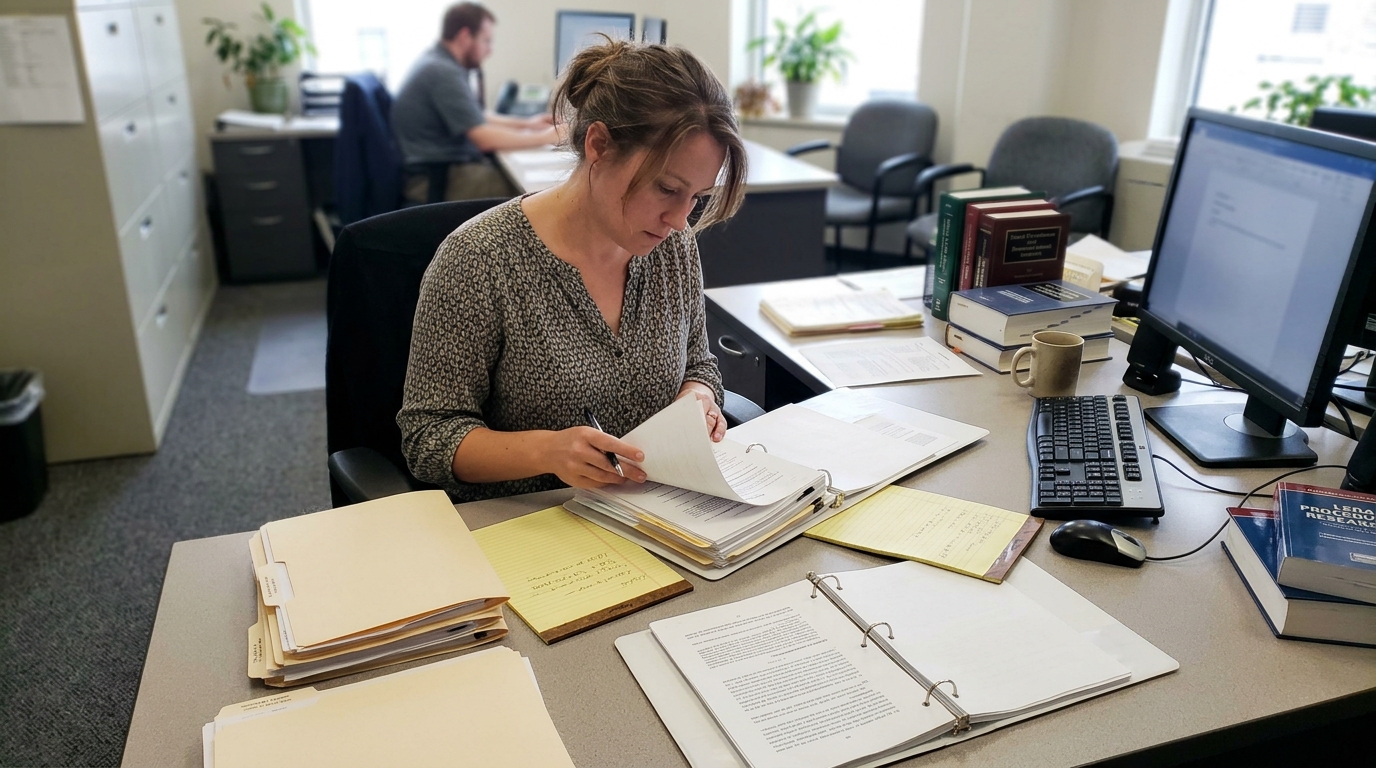
Paralegal work is one of the more open legal careers for career changers because there is no single fixed route in. The U.S. Bureau of Labor Statistics (2025) notes that some employers hire candidates with no legal experience or legal education and train them on the job, and that some accept a high school diploma plus experience — while others want a paralegal certificate or degree and a recognised certification.
Most switchers spend somewhere between 9 and 24 months moving from their current job to a first legal-support role, depending on whether they already hold a degree, how many hours a week they can study, and whether they sit a certification exam.
How Your Background Transfers
The BLS (2025) says entry often rests on work experience in a related occupation plus on-the-job training, so the question is which of your current tasks a hiring attorney recognises.
Executive or medical administrative assistants. Calendar control, travel and meeting logistics, correspondence drafting, and document version control map almost one-to-one onto docket management, deadline calendaring, and exhibit assembly. If you already produce long documents with Microsoft Word styles, numbered headings and tables of authorities-style formatting, and you handle PDFs in Adobe Acrobat, you are doing work a litigation team pays for. Billing or time-tracking experience transfers to the six-minute increment billing used in most firms.
Insurance claims adjusters and examiners. You already take recorded statements, build chronologies from medical records, read policy language against facts, and write summaries a decision-maker relies on. Those are the same tasks as drafting a case chronology, summarising deposition transcripts, and preparing demand packages in personal injury or insurance defence work.
Registered nurses and medical records staff. Reading and ordering clinical records, and explaining them in plain English, is the core of medical chronology work in personal injury, workers' compensation and mass tort practices. HIPAA-governed records handling transfers to confidentiality duties.
Classroom teachers. Lesson research, source checking, and plain-language writing transfer to factual and legal research and writing — two of the areas the NFPA's Paralegal Advanced Competency Exam (PACE) covers (Lorman, reporting on NFPA programs).
Bookkeepers and military administrative specialists. Trust accounting, invoicing and records retention transfer to firm billing and file management. NALA offers a discount on the CP Exam application fee for verified military-connected applicants (NALA – The Paralegal Association), so keep your service documents accessible.
What does not transfer: nobody will let you give legal advice, sign pleadings or set strategy. Expect supervision from day one.
Your Transition Timeline
Realistic total: 9 to 24 months, from your first enquiry to a first paralegal or legal assistant offer. Degree-holders studying part-time sit at the short end; people starting from a high school diploma and building experience first sit at the long end.
Months 1–3 — Route decision and state rule check.
- Milestone: a written plan naming one education route and one certification target.
- Check your state. Paralegal regulation is not national: a few states set voluntary registration or title-use rules through the state supreme court or state bar, and most do not. Contact your state bar association's paralegal division or committee and get the current rule in writing before you pay anyone tuition.
- Cost: school application fees and official transcript fees. Each school and registrar publishes its own figures — ask for them in writing.
Months 2–9 — Coursework (if you choose it).
- Milestone: completion of an ABA-approved paralegal certificate or an associate/bachelor's programme. ABA-approved certificate programmes commonly run a part-time track aimed at people who already hold a degree, with its own admission requirements and published duration — the UC San Diego Division of Extended Studies extension programme is one example of that structure; check any programme's own published length, admission rules and total tuition.
- Cost: tuition plus books. Get the per-unit or total programme figure from the school's published fee schedule, and ask whether your employer's tuition assistance applies.
Months 8–14 — Certification exam.
- Milestone: pass NALA's Certified Paralegal (CP) exam or the NFPA Paralegal CORE Competency Exam (PCCE). NALA's CP credential is accredited by the National Commission for Certifying Agencies and has been acknowledged by the American Bar Association (NALA).
- Cost: NALA's standard CP application fee, Prometric onsite testing-center fees, and a retake fee if you must retest on the Knowledge and Skills Exam — all published by NALA; confirm the current amounts on NALA's exam fee page before you apply.
- Eligibility: the PCCE is aimed at new and early-career paralegals with a bachelor's degree in paralegal studies or equivalent education and experience (Lorman, reporting on NFPA programs).
Months 10–24 — Experience and job search.
- Milestone: 100+ hours of real legal work via an internship, pro bono clinic volunteering, or a legal secretary/file clerk role.
- Cost: mainly lost income if the placement is unpaid or part-time.
Step-by-Step: Making the Switch
- Confirm your state's rules (1–2 weeks, usually free). Email your state bar's paralegal committee and ask three questions: may I use the title "paralegal" here, is any registration required, and is a specific certification referenced in any rule. Requirements vary by state — do not rely on a national answer.
- Check the current pay picture before you commit (1 hour, free). Look up the median annual wage for paralegals and legal assistants in the BLS Occupational Outlook Handbook (U.S. Bureau of Labor Statistics, 2025) and compare it to your current pay and your household budget. The same page carries the projected employment change for 2025–35 and the projected annual openings, which the BLS says come mostly from workers transferring occupations or leaving the labour force.
- Pick one education route and get its fee schedule in writing (2–4 weeks). Compare routes on measurable differences, not feel: published programme length, total tuition, ABA approval status, and whether the programme's graduates are eligible for the CP or PCCE exam under each body's published eligibility rules.
- Choose your certification target early (1 week). The BLS (2025) says certification is not required but some employers prefer or require it, and that it means passing an exam, meeting education or work-experience eligibility rules, and completing continuing education to keep it. NFPA runs two programmes — the PCCE for new paralegals and PACE for experienced paralegals seeking advancement (Lorman). Longer-horizon options include the Professional Paralegal (PP) exam, which has four parts covering advanced communication, advanced substantive law, legal procedures and ethics, and legal technology, and the American Alliance Certified Paralegal (AACP), which requires at least five years of paralegal experience plus a certificate, associate or bachelor's degree from an ABA-accredited institution or a credential from a voting member school of the American Association for Paralegal Education (Indeed).
- Build three portfolio pieces (10–20 hours). A redacted case chronology, a two-page research memo with proper citation, and a clean exhibit index with Bates-stamped PDFs. These show detail orientation and research skill, which the BLS (2025) lists among the occupation's important qualities.
- Volunteer at a legal aid or court self-help clinic (4–8 hours a month). It gives you intake interviewing, form completion and e-filing exposure, plus a supervising attorney who can be a reference.
- Have 20 informational conversations (3 months, 30 minutes each). Target paralegal managers and solo practitioners in the practice area closest to your old job — claims people to insurance defence, nurses to personal injury.
- Write the career-change line and use it unchanged. Lead with the transferable task, not the change itself.
Sample line for a cover letter or first interview
"For eleven years I handled auto bodily-injury claims: I took recorded statements, built medical chronologies, and wrote the file summaries our counsel relied on. I finished an ABA-approved paralegal certificate in June and passed NALA's Certified Paralegal exam, so I am looking for a litigation support role where that records work is the job rather than a side task."
- Apply in batches of 10 and track responses (ongoing). Include legal secretary, file clerk and document review roles — the BLS (2025) notes some employers hire candidates with no legal experience and train them on the job, and that route is often how switchers get the first firm name on the résumé.
Before You Resign: Readiness Checklist
Each item is either done or not done. Do not resign on partial credit.
- You have written confirmation from your state bar on whether any registration or title rule applies to paralegals in your state.
- You have six months of living expenses saved, calculated from your actual monthly spend.
- You have compared the BLS median annual wage for paralegals and legal assistants (U.S. Bureau of Labor Statistics, 2025) against your household budget, in writing.
- You are enrolled in, or have completed, a named paralegal certificate or degree programme and hold its published total tuition figure in writing.
- You have confirmed your eligibility for your target exam under the issuing body's published rules — NALA for the Certified Paralegal, NFPA for the PCCE or PACE.
- You have budgeted the current NALA CP application fee, Prometric onsite testing-center fee, and one retake fee from NALA's published schedule (and claimed the military-connected discount if you qualify).
- You have completed at least 100 hours of legal internship, clinic or volunteer work with a supervisor who has agreed to be a reference.
- You have three portfolio samples, redacted and saved as PDFs.
- You have had at least one interview for a legal-support role and recorded what was asked.
- You know the continuing education hours required to keep your chosen certification valid and when the first cycle begins.
- Your health insurance plan for the gap period is confirmed and in writing.
Frequently asked questions
I'm in my late forties. Is that a problem?
Eligibility rules are built on education and experience, not age. The American Alliance Certified Paralegal credential, for example, requires at least five years of paralegal experience plus a certificate, associate or bachelor's degree from an ABA-accredited institution (Indeed). A long prior career in claims, nursing or administration is the evidence attorneys read for judgement and client handling. Plan 9 to 24 months and lead with the transferable tasks, not the date on your first diploma.
Do I have to get certified to be hired?
No. The U.S. Bureau of Labor Statistics (2025) says certification is not required, though some employers prefer or require it. NFPA runs two programmes — the PCCE for new paralegals and PACE for experienced ones (Lorman). NALA's Certified Paralegal is accredited by the National Commission for Certifying Agencies and acknowledged by the American Bar Association. Budget 3 to 6 months of study, plus NALA's published application and Prometric testing-center fees.
What is the real cost of switching?
Usually not tuition. The larger line is reduced or lost income during the 3 to 6 months you spend interning, volunteering or working part-time to get supervised hours. Add exam application fees, Prometric onsite testing-center fees and any retake fee from NALA's published schedule, plus the continuing education required to keep a certification valid (U.S. Bureau of Labor Statistics, 2025). Price all four before resigning.
Can I start without a paralegal qualification?
Sometimes. The BLS (2025) reports that some employers hire candidates with no legal experience or legal education and train them on the job, and that some accept a high school diploma plus experience. In practice they substitute something checkable: a portfolio, a legal secretary or file clerk track record, or clinic hours. Expect that route to sit at the 18 to 24 month end of the timeline rather than the 9 month end.
Sources
- U.S. Bureau of Labor Statistics — Paralegals and Legal Assistants : Occupational Outlook Handbook (2025)
- NALA - The Paralegal Association — Testing Fees – NALA