How to Become an Electrician Without a Degree
A diploma or GED, documented apprenticeship hours and a state licensing exam replace the degree — here is what each step demands and the order to do it in.
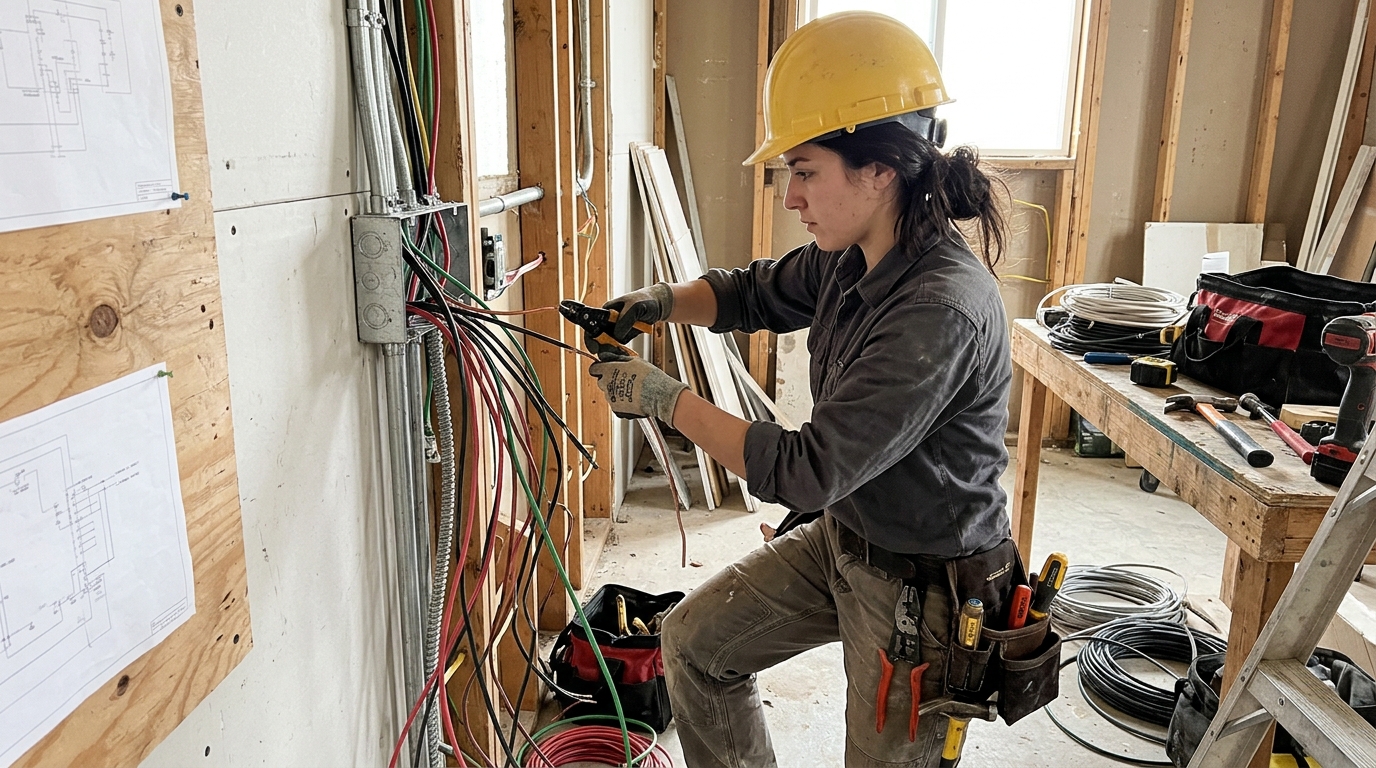
You do not need a college degree to become an electrician. The U.S. Bureau of Labor Statistics lists a high school diploma or equivalent as the education requirement, and says most electricians learn the trade through a 4- or 5-year apprenticeship with about 2,000 hours of paid on-the-job training per year plus technical instruction (U.S. Bureau of Labor Statistics, undated).
What stands in for a degree is documented hours, a passed aptitude test and, in most states, a licensing exam (U.S. Bureau of Labor Statistics, undated). The fastest realistic move is to get accepted into a registered apprenticeship — the application, aptitude test and interview alone typically take 2-3 months to navigate (NECA-IBEW Electrical Training Center, undated).
What Employers Accept Instead of a Degree
Electrical work is not a field where a bachelor's degree was ever the standard. ONET places electricians in Job Zone Three, 'Medium Preparation Needed', where occupations typically call for vocational school training, related on-the-job experience, or an associate's degree rather than a four-year degree (ONET OnLine, undated). What employers do insist on is documented, countable preparation.
These are the specific substitutes:
- A high school diploma or GED. This is the stated education requirement for electricians (U.S. Bureau of Labor Statistics, undated), and apprenticeship committees enforce it. The Hartford Electricians JATC (NECA & IBEW Local 35) requires applicants to be at least 17 at the time of application and to hold a high school diploma, GED, or two-year associate degree or higher (IBEW Local 35, undated).
- Documented apprenticeship hours. Union joint apprenticeship and training committees (JATCs) count hours, not credits. IBEW Local 26's Inside Wireman program requires a minimum of 8,000 hours of on-the-job training plus 900 hours of classroom instruction over five years (IBEW Local 26, undated). After completing an apprenticeship you are considered a journey worker and may perform duties on your own, subject to local or state licensing (U.S. Bureau of Labor Statistics, undated).
- A passed math requirement or aptitude test. The Hartford JATC requires applicants to have passed Algebra or the NJATC Tech Math Course, and to be drug free (IBEW Local 35, undated). Other JATCs run their own aptitude test as part of the application.
- A state license earned by exam. Most states require electricians to pass a test and be licensed (U.S. Bureau of Labor Statistics, undated). Requirements vary by state and locality (U.S. Bureau of Labor Statistics, undated), so confirm the hour counts and exam scope with your own state licensing board before you plan around them.
- Military electrical experience. Workers who gained electrical experience in the military or in construction may qualify for a shortened apprenticeship based on their experience and testing (U.S. Bureau of Labor Statistics, undated). The Department of Defense's Credentialing Opportunities On-Line program lists 'Electrician' (code 0159D) as a United Services Military Apprenticeship Program path for Army service members (Army COOL, undated).
- A pre-apprenticeship certificate. The Home Builders Institute runs a preapprenticeship certificate training (PACT) program covering eight construction trades, including electricians (U.S. Bureau of Labor Statistics, undated). It is a way into the applicant pool, not a licence to wire on your own.
Who accepts what differs by segment. Union JATCs sponsored jointly by NECA chapters and IBEW locals run the registered hour-based programs. Contractor associations also sponsor apprenticeships, and some electrical contractors run their own training programs that are not recognized apprenticeships but still combine technical and on-the-job training (U.S. Bureau of Labor Statistics, undated) — ask in writing whether the hours will count toward your state's licensing requirement before you sign on.
Compare Your Fastest Entry Options
Every path below is a real, searchable program type. Costs for applications, books, tools and licensing exams vary by committee and by state; ask each program for its published fee schedule and check your state licensing board for exam fees rather than relying on a national figure.
| Path | Duration and hours | What it costs you | Placement likelihood |
|---|---|---|---|
| Registered inside wireman apprenticeship (NECA-IBEW JATC) | 4-5 years; 8,000 on-the-job hours — IBEW Local 26 adds 900 classroom hours over five years, NECA-IBEW 193 pairs 8,000 OJT hours with 720 classroom hours in four years (IBEW Local 26, undated; NECA-IBEW 193 JATC, undated) | On-the-job training is paid (U.S. Bureau of Labor Statistics, undated); application, test and class fees vary by JATC | Strongest: you are hired into the job as an apprentice, but entry is ranked — the application, aptitude test and interview take 2-3 months and place you on an eligible-to-hire list (NECA-IBEW Electrical Training Center, undated) |
| Limited residential construction apprenticeship | 4,000 hours and 5 terms of school at the NECA-IBEW Electrical JATC in Oregon (NECA-IBEW Electrical Training Center, undated) | Paid on-the-job training; fees vary by program | Half the hours of the 8,000-hour inside electrician program, so faster to completion, but the scope of work it licenses you for is narrower |
| Telecommunications electrician apprenticeship | 3 years; 480 classroom hours plus 6,000 on-the-job hours (NECA-IBEW 193 JATC, undated) | Paid on-the-job training; fees vary by program | Shortest registered route listed here by 2,000 hours, in a specific niche rather than general wiring |
| HBI PACT pre-apprenticeship | Short course before an apprenticeship; covers eight construction trades including electricians (U.S. Bureau of Labor Statistics, undated) | Varies; confirm with the provider | No journey status on its own — it strengthens an apprenticeship application rather than replacing one |
| USMAP / military electrical experience | Varies by service record; 'Electrician' code 0159D is a USMAP credential path for Army service members (Army COOL, undated) | Completed during service | Can qualify you for a shortened apprenticeship after experience review and testing (U.S. Bureau of Labor Statistics, undated) |
| Non-registered contractor training program | Varies by employer; combines technical and on-the-job training (U.S. Bureau of Labor Statistics, undated) | Varies by employer | Hires can be faster, but hours may not count toward licensing — verify with your state board first |
One more structural difference worth noting: the Joint Industry Board of the Electrical Industry's IBEW Local 3 program runs five and one-half years, with four years at a minimum of 35 hours per week of on-the-job training, 4 hours per week of related instruction and 3 hours per week of college courses leading to an associate degree, followed by an 18-month fifth period (Joint Industry Board of the Electrical Industry, undated). If you want the degree anyway, that structure builds it in.
Step-by-Step: Fastest Path to a First Job
Realistic minimum from decision to your first paid day as an apprentice: 3-6 months, driven largely by the 2-3 months a JATC application, aptitude test and interview typically take (NECA-IBEW Electrical Training Center, undated) and by when the next intake opens. Journey worker status then takes 3-5 years of logged hours (U.S. Bureau of Labor Statistics, undated; NECA-IBEW 193 JATC, undated).
- Secure your high school diploma or GED (weeks to months, depending on where you start). This is the stated education requirement (U.S. Bureau of Labor Statistics, undated) and a documented JATC admission condition (IBEW Local 35, undated). Order an official transcript or GED score report now — applications ask for it. Transcript fees vary by school district.
- Clear the math requirement (4-12 weeks if you need it). The Hartford JATC requires a passing grade in Algebra or completion of the NJATC Tech Math Course (IBEW Local 35, undated). Take the course or request the transcript page that proves it. Course fees vary by provider.
- Find the programs near you (1 week). CareerOneStop, sponsored by the U.S. Department of Labor, maintains an Occupation Profile and Local Training Finder for electricians plus an apprenticeship office locator (CareerOneStop, undated). Use the locator to list every sponsoring JATC and contractor association in range.
- Check your state's licensing rules before you commit (1-2 days). Varies by state. Most states require electricians to pass a test and be licensed, and apprenticeship requirements vary by state and locality (U.S. Bureau of Labor Statistics, undated). Confirm with your state licensing board which programs' hours it accepts and what the exam application fee is.
- Submit the application and sit the aptitude test and interview (2-3 months). Expect to supply a diploma or GED, transcripts, a government ID, and — if you served — your DD-214 and USMAP records. You are then placed on a ranked eligible-to-hire list (NECA-IBEW Electrical Training Center, undated). Application fees vary by committee; ask what is refundable.
- If you have military or construction electrical experience, request an experience review (add 2-4 weeks). It may qualify you for a shortened apprenticeship based on experience and testing (U.S. Bureau of Labor Statistics, undated).
- Accept placement and start logging hours (day one of 3-5 years). Plan around roughly 2,000 hours of paid on-the-job training per year plus technical instruction (U.S. Bureau of Labor Statistics, undated), on top of classroom terms — 10 terms of school for the NECA-IBEW inside electrician program (NECA-IBEW Electrical Training Center, undated).
- Apply for your license when hours are complete. Varies by state. After the apprenticeship you are a journey worker and may work on your own, subject to local or state licensing (U.S. Bureau of Labor Statistics, undated). File the exam application with your state board and pay its published fee.
What You'll Still Need to Prove
Every item here is binary — you either have the document or you do not. Collect them in a single folder before you apply.
- [ ] High school diploma, GED certificate, or two-year associate degree or higher, with an official transcript or score report (U.S. Bureau of Labor Statistics, undated; IBEW Local 35, undated).
- [ ] Transcript page or course certificate showing a passing grade in Algebra, or completion of the NJATC Tech Math Course (IBEW Local 35, undated).
- [ ] Proof you meet the minimum age for your committee — at least 17 at time of application at the Hartford JATC (IBEW Local 35, undated).
- [ ] Government-issued photo ID and a valid driver's licence if the program or contractor requires one.
- [ ] Aptitude test result and interview completion from the JATC, and your position on its ranked eligible-to-hire list (NECA-IBEW Electrical Training Center, undated).
- [ ] A drug screen result, where the committee requires applicants to be drug free (IBEW Local 35, undated).
- [ ] DD-214 and USMAP completion records if you are claiming military electrical experience, including the 'Electrician' 0159D path (Army COOL, undated).
- [ ] Signed hour logs or an apprenticeship completion certificate showing the required totals — for example 8,000 on-the-job hours plus 900 classroom hours (IBEW Local 26, undated).
- [ ] Written confirmation from any non-registered contractor training program that its hours count toward your state's licensing requirement (U.S. Bureau of Labor Statistics, undated).
- [ ] Your state licensing exam result and licence number once issued — most states require both a passed test and a licence (U.S. Bureau of Labor Statistics, undated). Requirements vary by state; verify with your state board.
- [ ] Two or three work references with current phone numbers, ideally from supervisors who can confirm tool use and attendance.
Frequently asked questions
What is the absolute fastest registered route in?
Among registered programs, a telecommunications electrician apprenticeship runs three years, combining 480 classroom hours with 6,000 on-the-job hours (NECA-IBEW 193 JATC, undated) — 2,000 fewer on-the-job hours than an 8,000-hour inside wireman program. Getting accepted takes 2-3 months for the application, aptitude test and interview (NECA-IBEW Electrical Training Center, undated), so budget 3-6 months before your first paid day.
Does entering without a degree cap your pay or advancement?
Advancement runs on hours and licences, not diplomas. After an apprenticeship you are a journey worker and may perform duties on your own, subject to local or state licensing (U.S. Bureau of Labor Statistics, undated). Further steps are state board exams, which vary by state. If you want the credential anyway, the IBEW Local 3 program includes 3 hours per week of college courses leading to an associate degree (Joint Industry Board of the Electrical Industry, undated). Check current pay rates on CareerOneStop's electrician Occupation Profile.
Do I need a licence everywhere in the US?
Most states require electricians to pass a test and be licensed, and requirements vary by state and locality (U.S. Bureau of Labor Statistics, undated). There is no single national rule, so check your own state licensing board for the hour totals it accepts, the exam scope and the current application fee before you enrol in any program.
Can military service count toward the hours?
Yes, potentially. Workers with electrical experience from the military or construction may qualify for a shortened apprenticeship based on experience and testing (U.S. Bureau of Labor Statistics, undated). Army service members can pursue 'Electrician' (code 0159D) as a United Services Military Apprenticeship Program credential (Army COOL, undated). Bring your DD-214 and USMAP records to the experience review.
Is a pre-apprenticeship course worth doing first?
It helps your application, not your licence. The Home Builders Institute's preapprenticeship certificate training (PACT) program covers eight construction trades including electricians (U.S. Bureau of Labor Statistics, undated), but you still need the full apprenticeship — 4,000 hours for a limited residential program, 8,000 for inside wireman (NECA-IBEW Electrical Training Center, undated). Ask the provider for its current fee schedule.
Sources
- U.S. Bureau of Labor Statistics — Electricians : Occupational Outlook Handbook
- U.S. Bureau of Labor Statistics — Electricians : Occupational Outlook Handbook