How to Become an HVAC Technician: Step-by-Step Guide
Training runs from six months to two years, the EPA refrigerant exam is required nationwide, and licensing depends on the state and city you work in.
Most people enter HVAC work by completing a postsecondary certificate or associate's degree in HVACR, passing the EPA Section 608 refrigerant exam, and then learning the trade on the job with a contractor. The U.S. Bureau of Labor Statistics (2025) lists a postsecondary nondegree award as the typical entry-level education, no prior work experience in a related occupation, and long-term on-the-job training after hire.
Postsecondary HVACR programs generally last from six months to two years (U.S. Bureau of Labor Statistics), while apprenticeships combine paid work with classroom instruction and usually run several years. Licensing is not national: some states and localities require HVAC technicians to be licensed, so check your own state board before you enroll anywhere.
What the Job Actually Involves
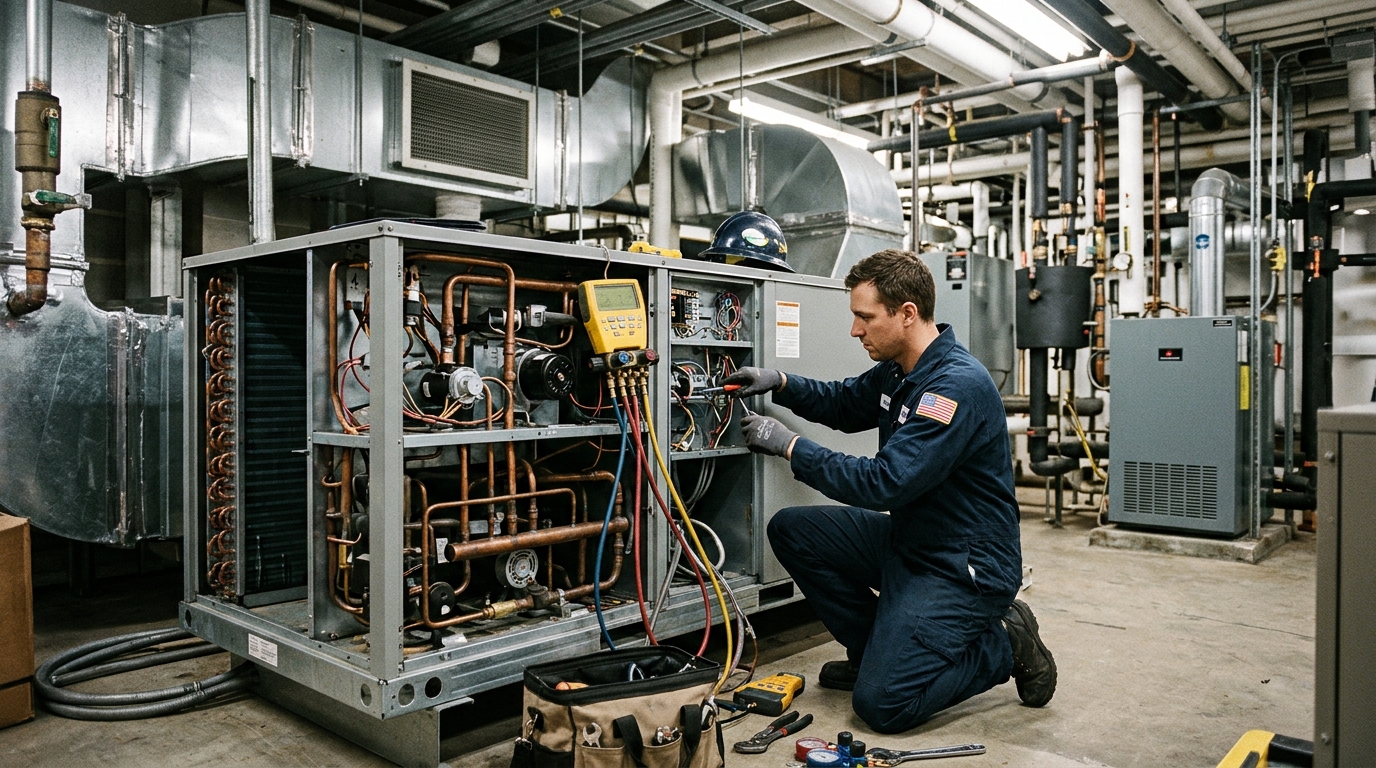
Most of the work is diagnosis, repair, installation and preventive maintenance on heating, cooling and refrigeration equipment. A typical residential service day means a run of dispatched calls: you arrive, interview the customer, then check the system with a clamp meter and multimeter for voltage, amperage and capacitor condition, attach a manifold gauge set or digital probes to read suction and head pressure, measure superheat and subcooling, and inspect the evaporator coil, blower wheel and condensate drain.
Repairs involve recovering refrigerant with a recovery machine and cylinder, cutting and brazing line sets with a torch and nitrogen purge, pulling a vacuum with a vacuum pump and confirming it with a micron gauge, then weighing in the charge with a digital refrigerant scale. On gas furnaces you use a combustion analyzer to check carbon monoxide and flue gas, and a manometer for gas pressure. Install days involve sheet metal snips, drills, flex duct, condensate pumps, thermostat wiring, and lifting condensers and air handlers. Paperwork runs on a tablet: dispatch and invoicing software, photos of the equipment nameplate, and parts ordering.
Settings range from attics, crawlspaces and basements to commercial rooftops, mechanical rooms and supermarket refrigeration racks. About 68% of heating, air conditioning, and refrigeration mechanics and installers were employed by plumbing, heating, and air-conditioning contractors (U.S. Bureau of Labor Statistics, 2025).
Most technicians work full time, with schedules that may include evening or weekend shifts (U.S. Bureau of Labor Statistics). Expect on-call rotations for emergencies and overtime or irregular hours during peak heating and cooling seasons.
Step-by-Step Path to Entry
- Finish high school or an equivalency credential. Take algebra, physics and any shop or electrical electives offered. A driver's license with a clean record matters because service work means driving a company van between calls.
- Choose a training route. Postsecondary HVACR programs at technical/trade schools or community colleges generally last from six months to two years and lead to a certificate or an associate's degree (U.S. Bureau of Labor Statistics). Program titles to look for include Heating, Air Conditioning, Ventilation and Refrigeration Maintenance Technology/Technician and Heating, Ventilation, Air Conditioning and Refrigeration Engineering Technology/Technician (CareerOneStop). Tuition varies widely by school and state — compare the published total cost, including tools and exam fees, on each program's own cost sheet before enrolling.
- Or apply to a registered apprenticeship instead. Apprenticeships usually last several years and combine paid on-the-job training with technical instruction each year (U.S. Bureau of Labor Statistics). This step replaces step 2 rather than following it; apprentices earn while they learn, so the out-of-pocket cost is lower than classroom-only training.
- Pass the EPA Section 608 exam. Section 608 of the Clean Air Act requires certification for anyone who maintains, services, repairs, or disposes of appliances containing ozone-depleting refrigerants (U.S. Environmental Protection Agency). The exam has four sections — Core, Type I, Type II and Type III — each with 25 multiple-choice questions, and you must pass Core plus at least one Type section with at least 18 of 25 correct; passing all sections gives Universal certification. Many postsecondary HVACR programs include this exam (U.S. Bureau of Labor Statistics). Check the current fee with the proctoring organization you test through.
- Apply for helper, installer or apprentice roles. Employers generally prefer applicants with a certificate or related associate's degree, or those who have completed an apprenticeship, and workers may need to pass a background check (CareerOneStop). Apply directly to plumbing, heating and air-conditioning contractors, which employ most technicians in the occupation.
- Complete long-term on-the-job training. People starting in this career usually have more than one year of on-the-job training (CareerOneStop), typically riding along and then running calls under a senior technician.
- Check state and local licensing. Some states and localities require HVAC technicians to be licensed (U.S. Bureau of Labor Statistics). Rules differ on experience hours, exams and whether a contractor licence is separate from a technician licence, so contact your state licensing board or city building department directly rather than relying on a national summary.
- Add manufacturer or industry certification. Steps 7 and 8 can run in parallel with step 6. NATE certification is awarded after passing a knowledge-based exam from the North American Technician Excellence organization, a coalition that includes the U.S. EPA and ASHRAE (Trane), and some employers prefer or require industry certification.
Education and Certification Options Compared
| Path | Credential earned | Typical duration | Typical cost | Satisfies state licensing? |
|---|---|---|---|---|
| Trade school or community college certificate in HVACR Maintenance Technology/Technician | Postsecondary certificate | 6 months to 2 years (U.S. Bureau of Labor Statistics) | Varies by school and state; compare each program's published tuition, tool and fee list | No on its own; may count toward experience or education requirements where a state licence exists |
| Community college associate's degree in HVACR Engineering Technology/Technician | Associate's degree | Up to 2 years (U.S. Bureau of Labor Statistics) | Varies by institution and residency status; check the college's published per-credit tuition | No on its own; check your state board for how degree hours are credited |
| Registered apprenticeship with a contractor or union | Completion certificate plus paid work hours | Several years, with technical instruction each year (U.S. Bureau of Labor Statistics) | Paid on-the-job training; ask the sponsor about tool, book and union fees | Often used to document required experience hours where licensing applies — confirm with the state board |
| EPA Section 608 certification (Core plus Type I, II, III or Universal) | Federal refrigerant handling certification | Single exam; no renewal required (Interplay Learning) | Exam fee set by the proctoring organization — confirm before booking | Required by federal law for refrigerant work, but separate from any state or local licence |
| NATE certification (core exam plus a specialty exam) | NATE certification, valid two years (three for ground source heat pump installer) | One exam sitting per credential; 16 hours of continuing education every two years to maintain (Lincoln Tech) | Exam fees published by the North American Technician Excellence organization | No; it is an industry credential some employers prefer or require |
Requirements Checklist Before You Apply
- Hold a high school diploma or equivalency credential.
- Hold a current EPA Section 608 certification at Type I, Type II, Type III or Universal level, with the card or certificate available as a PDF.
- Hold a valid driver's license and be able to provide a driving record if asked, since most service work is van-based.
- Have a certificate, associate's degree or completed apprenticeship to show in place of prior experience — the U.S. Bureau of Labor Statistics (2025) lists no related work experience as a requirement, and employers generally substitute a credential or apprenticeship completion (CareerOneStop).
- Be able to pass an employer background check and any drug screen; workers may need to pass a background check for this occupation (CareerOneStop).
- Have confirmed in writing, by phone or on your state board's website, whether your state or city requires an HVAC technician or contractor licence, and what it takes to qualify.
- Own the hand tools listed on the employer's job posting, or confirm the company supplies them.
- Be able to lift equipment, work on ladders and rooftops, and work in attics and crawlspaces, and meet any employer medical or fit-test requirement.
- Be available for evening or weekend shifts and on-call rotations, which are common in this occupation (U.S. Bureau of Labor Statistics).
- Have a transcript or program completion letter, EPA card, and references from instructors or past supervisors ready to attach to applications.
Frequently asked questions
How long does it take to become an HVAC technician?
Postsecondary HVACR programs generally last from six months to two years and lead to a certificate or associate's degree (U.S. Bureau of Labor Statistics). Apprenticeships usually last several years but pay you while you train. After hire, expect long-term on-the-job training — people starting in the career typically have more than one year of it (CareerOneStop) before working calls independently.
Do I need a license to work on HVAC systems?
EPA Section 608 certification is required by federal law for anyone who maintains, services, repairs or disposes of appliances containing ozone-depleting refrigerants (U.S. Environmental Protection Agency). A state or local licence is separate: some states and localities require HVAC technicians to be licensed and others do not (U.S. Bureau of Labor Statistics). Contact your state licensing board or city building department for the rule that applies where you plan to work.
What score do I need to pass the EPA 608 exam?
The exam has four sections — Core, Type I, Type II and Type III — each with 25 multiple-choice questions. You need at least 18 of 25 correct on the Core section plus at least one Type section; passing all four gives Universal certification. The certification is a one-time test with no expiration and no renewal requirement (Interplay Learning).
Can I get hired with no experience?
The U.S. Bureau of Labor Statistics (2025) lists no related work experience as a requirement for entry. Employers generally substitute a certificate, a related associate's degree, or a completed apprenticeship, plus your EPA Section 608 card (CareerOneStop). Expect to start as a helper or installer and complete more than a year of on-the-job training.
Is NATE certification worth getting?
Some employers prefer or require manufacturer or industry certification (U.S. Bureau of Labor Statistics). NATE certification requires passing the core exam plus at least one specialty exam and lasts two years, except the ground source heat pump installer certification, which lasts three (Trane). Maintaining it takes 16 hours of continuing education every two years, or retaking the specialty exam (Lincoln Tech).
What is the job outlook for HVAC technicians?
Employment of HVAC mechanics and installers is projected to grow 11% from 2025 to 2035, much faster than average, with about 40,600 openings projected each year on average over the decade (U.S. Bureau of Labor Statistics, 2025). About 68% of workers in the occupation were employed by plumbing, heating and air-conditioning contractors (U.S. Bureau of Labor Statistics, 2025).
Sources
- U.S. Bureau of Labor Statistics — Heating, Air Conditioning, and Refrigeration Mechanics and Installers : Occupational Outlook Handbook (2025)
- U.S. Environmental Protection Agency — EPA's Refrigerant Management Program: Questions and Answers for Section 608 Certified Technicians