Life as a Physical Therapist Assistant: What to Expect
Inside the hands-on clinical work, the licensing exam route and the physical demands behind helping patients move again after injury or surgery.
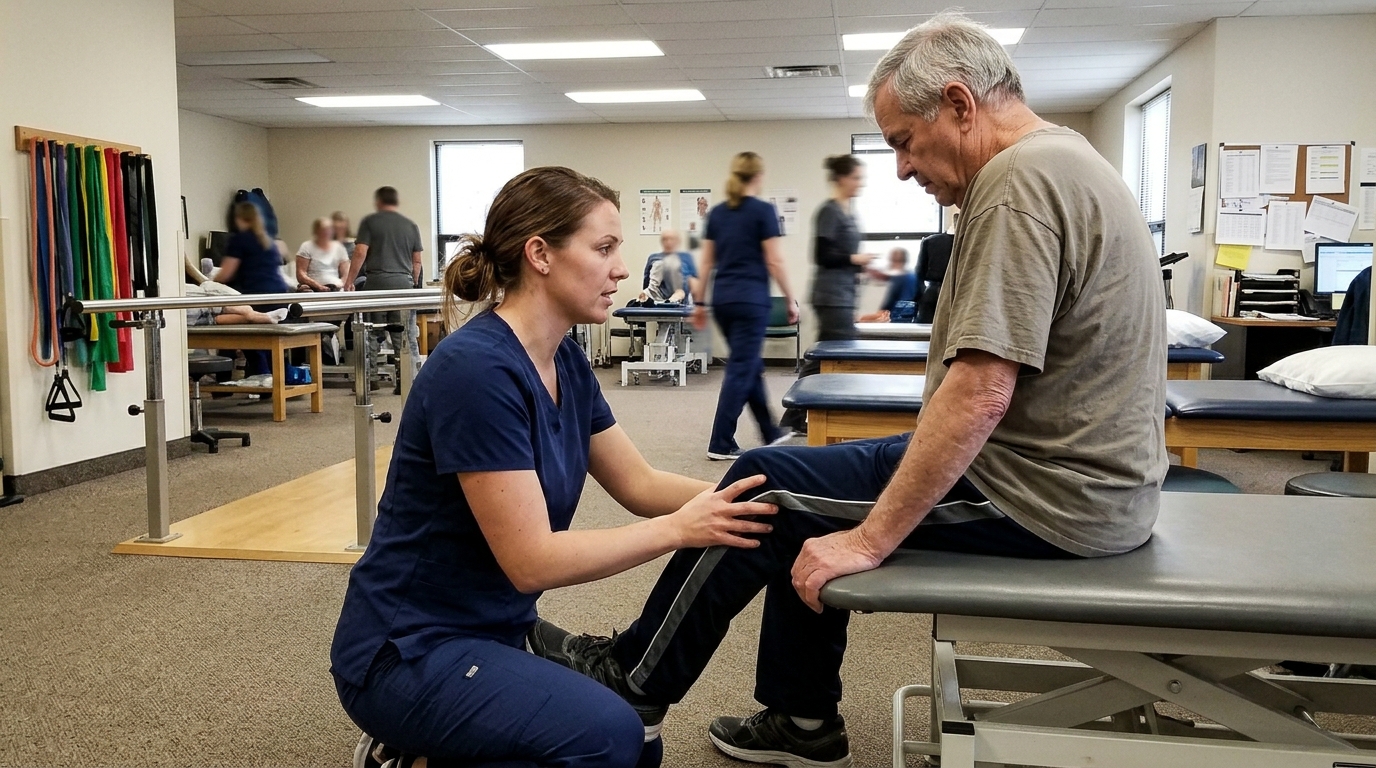
A physical therapist assistant (PTA) carries out treatment plans written by a physical therapist, guiding patients through exercises, hands-on techniques and mobility training after injury, surgery or illness (U.S. Bureau of Labor Statistics, 2025). It is close-contact, on-your-feet clinical work in outpatient clinics, hospitals, patients' homes and nursing facilities.
Entry runs through an associate's degree from an accredited program, usually about two years, followed by licensure in every state (U.S. Bureau of Labor Statistics, 2025).
What a Physical Therapist Assistant Does
You work under the direction and supervision of a licensed physical therapist, delivering the treatment written into each patient's plan of care (U.S. Bureau of Labor Statistics, 2025). The therapist evaluates the patient and sets the goals; you spend the appointment doing the therapy — coaching a knee replacement patient through step-ups, applying a hot pack, teaching safe walker use, measuring range of motion and reporting back what you saw.
Offices of physical, occupational and speech therapists and audiologists employ 44% of PTAs, hospitals 20%, home healthcare services 12%, nursing and skilled nursing facilities 10%, and offices of physicians 6% (U.S. Bureau of Labor Statistics, 2025). Setting changes the work: outpatient clinics lean toward orthopedic and sports recovery with two or three patients on the floor at once; skilled nursing toward older adults relearning transfers and gait; home health toward one patient in a living room with whatever equipment fits there. You also teach spouses and adult children how to continue care after treatment ends (U.S. Bureau of Labor Statistics, 2025).
Core Duties and Responsibilities
- Instruct, motivate, safeguard and assist patients as they practice exercises and functional activities — the task ONET ranks first for this occupation (ONET OnLine, U.S. Department of Labor, 2025).
- Observe patients before, during and after therapy and report their status to the supervising physical therapist (U.S. Bureau of Labor Statistics, 2025).
- Apply hands-on techniques such as massage and stretching as written into the plan of care (U.S. Bureau of Labor Statistics, 2025).
- Fit and train patients on devices such as walkers, crutches, canes and wheelchairs (U.S. Bureau of Labor Statistics, 2025).
- Guard patients through gait training, bed-to-chair transfers and sit-to-stand work at the mat table or parallel bars.
- Set up and disinfect hydrocollator packs, ultrasound units, electrical stimulation units, therapy bands and stationary bikes.
- Document each session in the clinic's electronic medical record, logging exercises, repetitions, pain reports and walking distance.
A Typical Day
7:30 AM — Open and prepare. Read the therapist's notes on new evaluations, lay out mats, fill hydrocollator packs and check that the ultrasound and e-stim units are working.
8:00 AM — First patients. Back-to-back appointments, often two or three patients on the floor at once in outpatient settings. You cue form, count repetitions, apply manual therapy and chart between visits.
10:30 AM — The unpredictable block. A post-surgical patient arrives with a swollen, hot knee and new pain. You stop the planned exercise, flag it to the supervising physical therapist immediately, and the visit changes on the spot.
1:00 PM — Afternoon caseload. Gait training in the parallel bars, a walker fitting, and teaching a patient's daughter how to spot a safe transfer from bed to chair.
4:30 PM — Teaching and close down. Walk a patient through a printed home exercise program, update the therapist on anyone whose progress has stalled, wipe equipment and finish charting. Clinics with extended hours run a later shift instead (U.S. Bureau of Labor Statistics, 2025).
Work Environment
- Indoors in an environmentally controlled setting every day, according to the ONET Work Context survey (ONET OnLine, U.S. Department of Labor, 2025) — except home health PTAs, who drive between houses.
- On your feet and moving for most of the shift to set up equipment and treat patients; lifting and moving patients makes back injury a recognized risk (U.S. Bureau of Labor Statistics, 2025).
- Constant contact with others and very close physical proximity — near touching — because guarding and manual therapy require it (O*NET OnLine, U.S. Department of Labor, 2025).
- Exposure to disease or infections reported as a daily condition, so gloves, hand hygiene and equipment disinfection are routine (O*NET OnLine, U.S. Department of Labor, 2025).
- Most PTAs work full time, part-time work is common, and some work nights and weekends because many clinics keep extended hours (U.S. Bureau of Labor Statistics, 2025). Travel is effectively none in a single outpatient clinic but daily in home healthcare services, which employ 12% of PTAs.
Skills and Qualifications
| Requirement | Detail |
|---|---|
| Associate's degree from an accredited PTA program | Required in all states; about 2 years, covering anatomy, physiology and kinesiology plus supervised clinical work (U.S. Bureau of Labor Statistics, 2025) |
| CAPTE-accredited institution | NPTE eligibility requires a degree appropriate for the exam level from a CAPTE-accredited institution, or substantially equivalent education (Federation of State Boards of Physical Therapy) |
| National Physical Therapy Examination (NPTE), PTA level | Register and pay the fee through FSBPT and be approved by your state licensing board; attempts are capped at three consecutive and six in a lifetime per exam level (Federation of State Boards of Physical Therapy) |
| State license or certification | Required in every state; some states add a state law exam, a criminal background check and a minimum age of 18 (U.S. Bureau of Labor Statistics, 2025) |
| Preparation level | ONET places PTAs in Job Zone Three, "Medium Preparation Needed" (ONET OnLine, U.S. Department of Labor, 2025) |
| Employer add-ons | Many clinics ask for current CPR certification and documented immunizations before your first shift; check the posting, as this is not set by state law |
Salary and Job Outlook
Pay is usually an hourly rate in outpatient and home health settings and an annual salary in some hospital roles, with differentials for evenings, weekends and per-visit home health work. Rates vary by state and setting, so check current figures directly.
| Measure | What the data shows and where to check |
|---|---|
| Entry-level pay | Sits in the lower percentiles; the Bureau of Labor Statistics publishes 10th and 25th percentile wages for physical therapist assistants in its Occupational Employment and Wage Statistics tables (U.S. Bureau of Labor Statistics, 2025) |
| Median pay | A median annual wage for physical therapist assistants was published for May 2025 (U.S. Bureau of Labor Statistics, 2025); ONET also lists a median wage for the occupation (ONET OnLine, U.S. Department of Labor, 2025) |
| Experienced pay | Shown in the 75th and 90th percentile figures in the same BLS tables, broken out by industry and state (U.S. Bureau of Labor Statistics, 2025) |
| Job growth | Projected to grow much faster than average from 2025 to 2035, with about 24,900 openings a year on average over the decade for PTAs and aides (U.S. Bureau of Labor Statistics, 2025); ONET projects the same for PTAs specifically (ONET OnLine, U.S. Department of Labor, 2025) |
How to Get Started
- Check your state board's requirements first. Some states add a state law exam, a criminal background check and a minimum age of 18 on top of the national exam (U.S. Bureau of Labor Statistics, 2025).
- Enroll in a CAPTE-accredited PTA associate's degree program. Plan on about two years of anatomy, physiology and kinesiology coursework plus supervised clinical rotations (U.S. Bureau of Labor Statistics, 2025); accreditation is what makes you NPTE-eligible (Federation of State Boards of Physical Therapy).
- Complete your clinical placements. These rotations put you in outpatient clinics, hospitals or skilled nursing facilities, and they are where most graduates meet their first employers.
- Register for the NPTE at the PTA level with FSBPT. Pay the registration fee, hold the qualifying degree and get approved by the board in the state where you want to practice; attempts are limited to three consecutive and six lifetime (Federation of State Boards of Physical Therapy).
- Apply for your state license or certification, completing any jurisprudence exam, background check and fingerprinting the board requires, then apply to the settings that hire most: therapy offices (44%) and hospitals (20%) (U.S. Bureau of Labor Statistics, 2025).
Frequently asked questions
How long does it take to become a physical therapist assistant?
Plan on about two years for the associate's degree from an accredited program, covering anatomy, physiology and kinesiology plus supervised clinical work (U.S. Bureau of Labor Statistics, 2025). After graduation, add time for the National Physical Therapy Examination and state licensing paperwork, which can run several weeks to a few months depending on the board. Many programs also require prerequisite science courses before you apply.
What is the difference between a PTA and a physical therapy aide?
A PTA is licensed or certified in every state and holds an accredited associate's degree of roughly two years; aides generally need no degree and learn on the job (U.S. Bureau of Labor Statistics, 2025). That two-year training gap is why PTAs deliver treatment from the plan of care while aides mainly clean equipment, move patients between areas and handle clerical work. The Bureau of Labor Statistics reports wage data separately for the two roles.
How physically demanding is the work?
You are on your feet and moving to set up equipment and treat patients, and lifting and moving patients makes PTAs vulnerable to back injuries (U.S. Bureau of Labor Statistics, 2025). O*NET respondents report working in very close physical proximity — near touching — and being exposed to disease or infections every day (O*NET OnLine, U.S. Department of Labor, 2025). Body mechanics, gait belts and transfer equipment matter from day one.
Can I fail the NPTE and retake it?
Retakes are allowed but capped: FSBPT permits a maximum of three consecutive attempts per exam level before you cannot register for the next exam date, and six attempts in a lifetime per level (Federation of State Boards of Physical Therapy). You also need to stay approved by the licensing board in your state to re-register. Treat the first attempt as the one that counts.
Sources
- U.S. Bureau of Labor Statistics — Physical Therapist Assistants and Aides : Occupational Outlook Handbook (2025)
- O*NET OnLine (U.S. Department of Labor) — 31-2021.00 - Physical Therapist Assistants (2025)