LPN vs RN: Which Nursing Career Path Fits You?
Both roles run on shift work and hours on your feet, but one takes about a year of schooling and the other up to four — and the scope of practice differs.
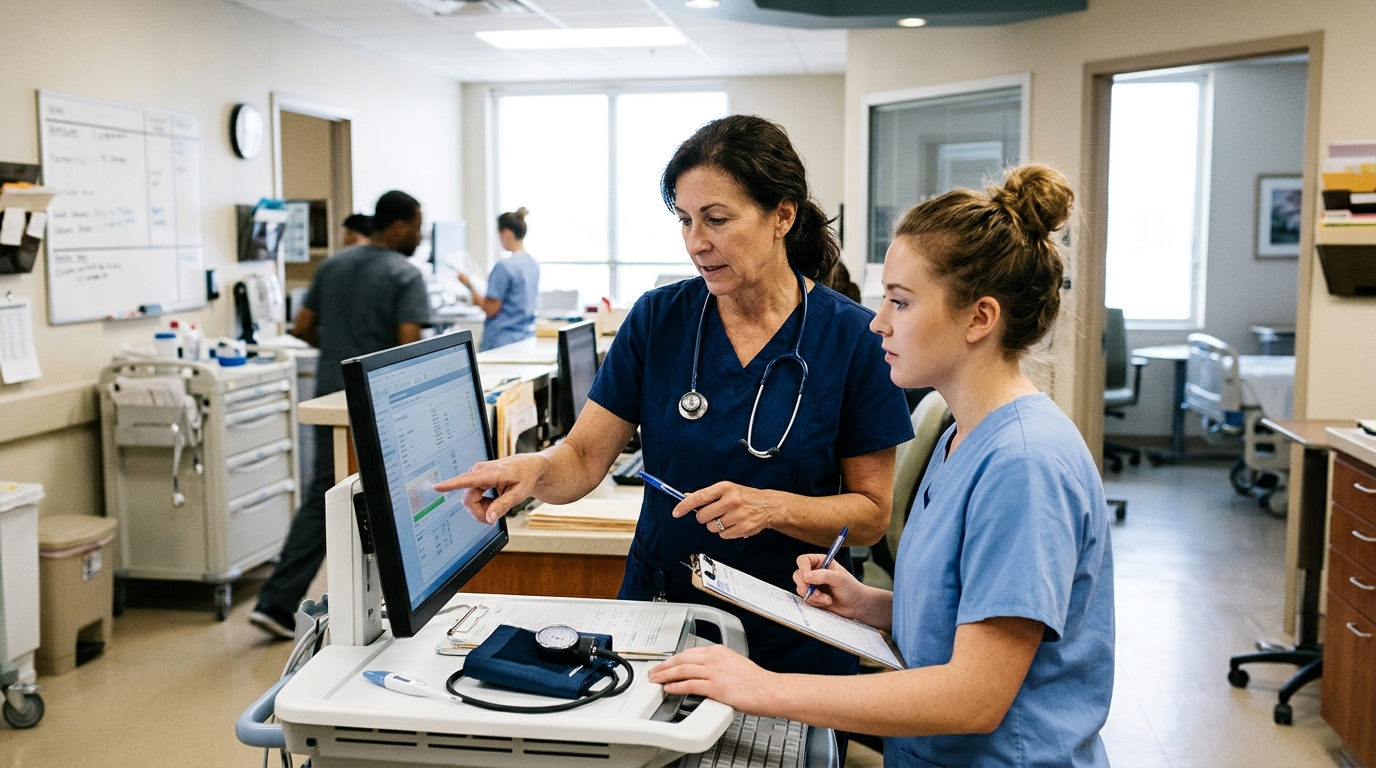
LPNs/LVNs and RNs work the same hallways and often the same patients, but they are separate licenses with separate training. An LPN/LVN certificate or diploma program typically takes about 1 year at a community college or technical school, while BSN and associate degree programs typically take 4 years and diploma programs 2 to 3 (U.S. Bureau of Labor Statistics, 2026). The LPN role centers on monitoring vital signs and hands-on basic care reported up to an RN or physician; the RN role centers on assessing patients, administering medicines and treatments, and setting up care plans (U.S. Bureau of Labor Statistics, 2026).
If you want to be working in scrubs inside a year, the LPN route is the shorter door. If you want to write the care plan rather than carry it out, you are looking at the RN route.
Side-by-Side Comparison
| Dimension | LPN / LVN | Registered Nurse (RN) |
|---|---|---|
| Median pay | A median annual wage is published for Licensed Practical and Licensed Vocational Nurses (U.S. Bureau of Labor Statistics, 2025); pay is usually hourly with differentials for nights, weekends and holidays. Check the current figure in the BLS Occupational Outlook Handbook. | A separate median annual wage is published for Registered Nurses (U.S. Bureau of Labor Statistics, 2025); hospital RNs are typically hourly with shift differentials, while clinic and school roles are more often salaried. |
| Typical hours | Most work full time; some work nights, weekends and holidays, and shifts may run longer than 8 hours (U.S. Bureau of Labor Statistics, 2026). | Hospital and nursing-facility nurses work shifts for round-the-clock coverage, including nights, weekends and holidays, and may be on call (U.S. Bureau of Labor Statistics, 2026). |
| Education required | State-approved certificate or diploma program, commonly at a community college or technical school, typically about 1 year, then pass the licensing exam (U.S. Bureau of Labor Statistics, 2026). | Graduate an approved nursing program — BSN 4 years, associate degree 4 years, diploma 2 to 3 years — then pass the qualifying exam for a state license (U.S. Bureau of Labor Statistics, 2026). |
| Physical demands | Bedside work: bathe, dress and reposition patients and change bandages; ONET surveys this occupation on time spent standing (National Center for ONET Development). | Walking, bending, stretching and standing for much of the shift, with back-injury risk from lifting and moving patients (U.S. Bureau of Labor Statistics, 2026). |
| Primary duties | Monitor vital signs, change bandages, help with bathing and dressing, and report patient status to registered nurses or physicians (U.S. Bureau of Labor Statistics, 2026). | Assess patients' conditions, administer medicines and treatments, set up care plans, and operate and monitor medical equipment (U.S. Bureau of Labor Statistics, 2026). |
Day-to-Day Differences
An LPN shift is built around repetition at the bedside. You take and record vital signs on a round of patients, change dressings, help residents bathe and dress, reposition people who cannot move themselves, and flag anything that has changed — a rising temperature, a wound that looks worse — to the RN or physician on duty (U.S. Bureau of Labor Statistics, 2026). Most of the hours are spent in patient rooms rather than at a station, and you hand off what you observe rather than deciding what to do about it.
An RN shift starts with assessment. You work through your assigned patients, judge how each is doing, then set up or revise the care plan the rest of the team works from. Through the shift you administer medicines and treatments on schedule, and you set up, operate and monitor equipment such as infusion pumps and cardiac monitors (U.S. Bureau of Labor Statistics, 2026). You also absorb the reports coming up from LPNs and aides and decide what changes in response.
The practical split: LPNs report findings, RNs act on them and document the plan. Both roles involve walking, bending, stretching and standing, and lifting patients carries real back-injury risk (U.S. Bureau of Labor Statistics, 2026).
Who Each Job Fits Best
The LPN/LVN route fits you if:
- You want to be licensed and working inside about a year, since certificate and diploma programs typically take roughly 1 year (U.S. Bureau of Labor Statistics, 2026).
- You prefer hands-on tasks — change bandages, help with bathing and dressing, record vital signs — over planning and documentation (U.S. Bureau of Labor Statistics, 2026).
- You are comfortable reporting up, since your findings go to an RN or physician who makes the call (U.S. Bureau of Labor Statistics, 2026).
- You can work shifts longer than 8 hours, including nights, weekends and holidays (U.S. Bureau of Labor Statistics, 2026).
The RN route fits you if:
- You can fund and sit out 2 to 4 years of schooling before licensure, depending on the diploma, associate or BSN path (U.S. Bureau of Labor Statistics, 2026).
- You want to assess patients and set up the care plan rather than carry out someone else's (U.S. Bureau of Labor Statistics, 2026).
- You will take responsibility for administering medicines and treatments and for monitoring equipment attached to a patient (U.S. Bureau of Labor Statistics, 2026).
- You can accept being on call on top of night, weekend and holiday rotations (U.S. Bureau of Labor Statistics, 2026).
Pay and Advancement
| Item | LPN / LVN | Registered Nurse (RN) |
|---|---|---|
| Entry pay | Usually hourly, set by employer and state market, with differentials for nights, weekends and holidays; the Occupational Outlook Handbook lists the lowest 10 percent alongside the median (U.S. Bureau of Labor Statistics, 2025). | Usually hourly in hospitals, with new-graduate rates stepping up after residency or probation; the same Handbook entry lists the lowest 10 percent for RNs (U.S. Bureau of Labor Statistics, 2025). |
| Median pay | Published as the median annual wage for Licensed Practical and Licensed Vocational Nurses (U.S. Bureau of Labor Statistics, 2025); your state figure may sit well above or below the national one. | Published as the median annual wage for Registered Nurses (U.S. Bureau of Labor Statistics, 2025); check state and industry breakdowns, since hospital, clinic and school pay differ. |
| Typical path to the next role | Advance with experience to a supervisory position such as charge nurse, or complete an LPN-to-RN education program (U.S. Bureau of Labor Statistics, 2026). | Move into charge nurse, specialty units or management; a state license obtained by graduating an approved program and passing the qualifying exam is required throughout (U.S. Bureau of Labor Statistics, 2026). |
Pay is set by employer, state and shift pattern, so treat national medians as a starting point and compare postings in your own city before you enroll.
Frequently asked questions
Can I start as an LPN and become an RN later?
Yes — some LPNs/LVNs complete an LPN-to-RN education program, while others advance into supervisory positions instead (U.S. Bureau of Labor Statistics, 2026). Working a year or two as an LPN first lets you earn while you decide, and bedside experience carries over. The trade-off is total time: the roughly 1-year LPN program comes first, and the RN program still has to be completed on top of it.
Which one pays more?
Separate median annual wages are published for Licensed Practical and Licensed Vocational Nurses and for Registered Nurses (U.S. Bureau of Labor Statistics, 2025), and the Occupational Outlook Handbook is where to compare both current figures and the state breakdowns. Pay in both roles is commonly hourly in hospitals and nursing care facilities, with differentials for nights, weekends and holidays. Because differentials and local market vary so much, read actual postings in your area alongside the national medians.
Is one role less physically demanding than the other?
Neither is a sitting job. RNs spend much of a shift walking, bending, stretching and standing, and face back-injury risk from lifting and moving patients (U.S. Bureau of Labor Statistics, 2026), while LPN duties such as bathing, dressing and bandage changes are equally hands-on. O*NET surveys both occupations on time spent standing (National Center for O*NET Development).
Do both require a state license?
Both do. Prospective LPNs/LVNs must finish a state-approved educational program and pass an exam before entering the occupation, and registered nurses must hold a license issued by the state where they work, obtained by graduating an approved program and passing a qualifying exam (U.S. Bureau of Labor Statistics, 2026). Titles, requirements and renewal rules are set state by state, so check with the board of nursing where you plan to work.
Sources
- U.S. Bureau of Labor Statistics — Licensed Practical and Licensed Vocational Nurses : Occupational Outlook Handbook (2025)
- U.S. Bureau of Labor Statistics — Registered Nurses : Occupational Outlook Handbook (2025)