Medical Assistant vs CNA: Which Healthcare Career Fits You?
One role mixes clinical tasks with front-desk work in an outpatient office; the other is hands-on bedside care, and the training hours differ sharply.
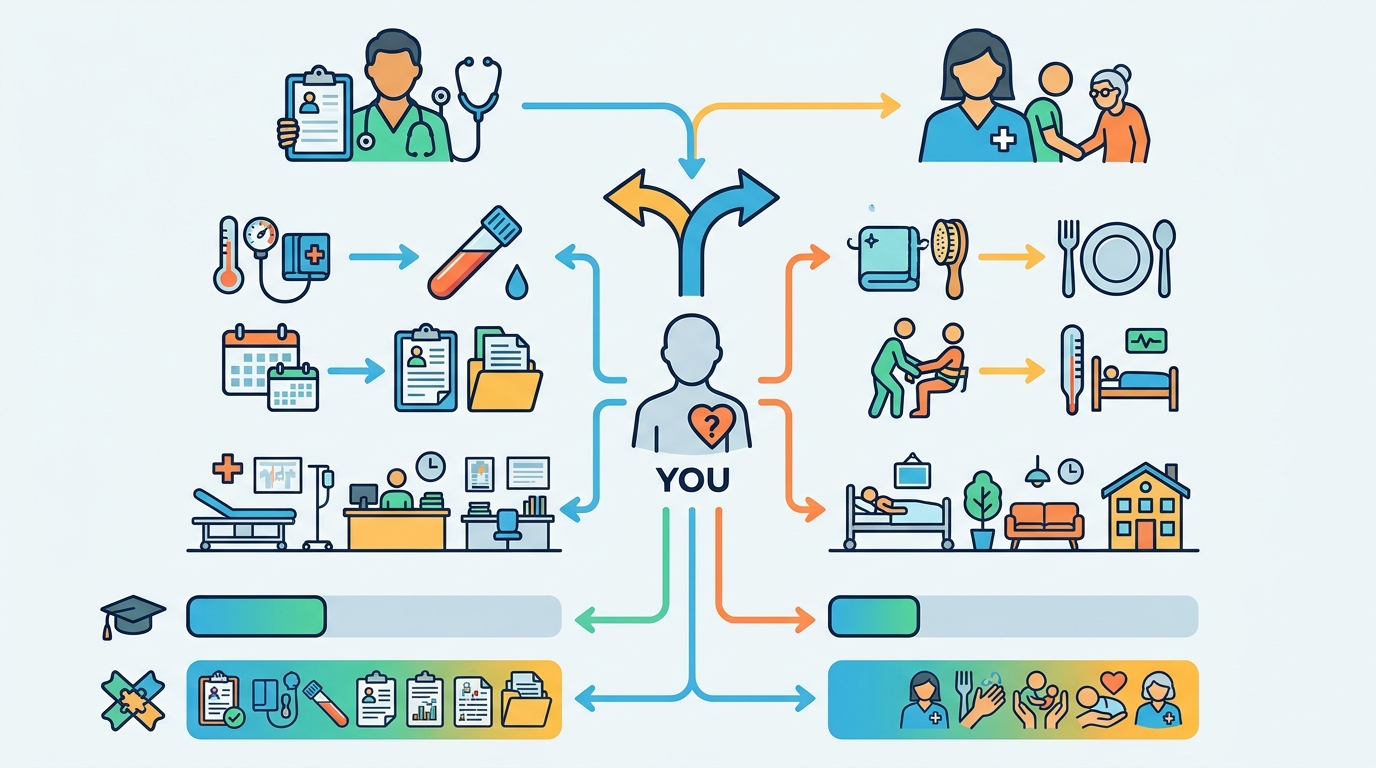
Medical assistants and certified nursing assistants both work under licensed clinicians, but the jobs point in different directions. A medical assistant usually works in a physician's office, taking vital signs, drawing lab samples, giving injections as directed by a physician and entering patient information into records (U.S. Bureau of Labor Statistics, 2025). A CNA provides basic care and helps patients with activities of daily living, which means lifting, turning and repositioning people for most of a shift (U.S. Bureau of Labor Statistics, 2025).
The fastest split to decide on is training: the federal baseline for nurse aide training is a minimum of 75 hours, while the main medical assisting credential generally expects an accredited program of at least 560 academic contact hours.
Side-by-Side Comparison
| Measure | Medical Assistant | Certified Nursing Assistant (CNA) |
|---|---|---|
| Median pay | The U.S. Bureau of Labor Statistics publishes a median annual and hourly wage for medical assistants (2025); read the current figure on the occupation's Occupational Outlook Handbook profile | The U.S. Bureau of Labor Statistics publishes a median annual wage for nursing assistants on its own, a separate one for orderlies, and a combined hourly and annual figure for the two groups (2025) |
| Typical hours | Most work full time, and some schedules include evenings, weekends and holidays because clinics extend office hours (U.S. Bureau of Labor Statistics, 2025) | Most work full time in settings that run 24 hours, so rotas include nights, weekends and holidays (U.S. Bureau of Labor Statistics, 2025) |
| Education required | A postsecondary nondegree award is the typical entry-level education (U.S. Bureau of Labor Statistics, 2025); the CMA (AAMA) exam generally requires graduating from a CAAHEP- or ABHES-accredited medical assisting program (American Association of Medical Assistants) | A state-approved nurse aide training program followed by a competency evaluation, after which the worker is listed on the state registry (U.S. Bureau of Labor Statistics, 2025); the federal floor is 75 hours with 16 clinical hours (RegisteredNursing.org) |
| Physical demands | Indoor clinic work, standing and walking between exam rooms, handling needles, sterilizing instruments and disposing of contaminated supplies (O*NET OnLine) | Physically demanding bedside work: lift, turn and reposition bedridden patients and stay on your feet for most of the shift (U.S. Bureau of Labor Statistics, 2025; O*NET OnLine) |
| Primary duties | Interview patients for medical history, measure vital signs, weight and height, collect and prepare blood and lab samples, give medications as directed by a physician, schedule appointments and enter data into records (U.S. Bureau of Labor Statistics, 2025; O*NET OnLine) | Provide basic care and help with activities of daily living, turn or reposition patients, and measure and record food and liquid intake and urinary and fecal output (U.S. Bureau of Labor Statistics, 2025; O*NET OnLine) |
| Common job titles | Certified Medical Assistant (CMA), Clinical Medical Assistant (O*NET OnLine) | Certified Nurse Aide, Certified Nursing Assistant, State Tested Nursing Assistant (STNA) (O*NET OnLine) |
Day-to-Day Differences
A medical assistant's hour usually follows the appointment book. You room a patient, interview them to obtain medical information, measure vital signs, weight and height, then type the findings into the chart before the clinician walks in (U.S. Bureau of Labor Statistics, 2025; O*NET OnLine). Between patients you draw and label blood for the lab courier, give an injection a physician has ordered, sterilize instruments, dispose of contaminated supplies and answer the phone to schedule the next visit. The work is indoor, clinic-paced and interrupted by clerical tasks.
A CNA's hour follows the patient, not the calendar. You help people bathe, dress, eat and use the toilet, turn or reposition bedridden patients on a set schedule to protect their skin, and measure and record food and liquid intake and urinary and fecal output (U.S. Bureau of Labor Statistics, 2025; O*NET OnLine). You answer call lights, report changes to the nurse and lift or transfer patients repeatedly, which is why the Bureau describes the role as physically demanding. Orderlies, counted in the same group by the Bureau, transport patients between units and clean treatment areas (U.S. Bureau of Labor Statistics, 2025). You will not be booking appointments or drawing blood.
Who Each Job Fits Best
Medical assistant suits you if:
- You want to perform clinical procedures such as giving injections and preparing blood samples, and you are willing to complete an accredited program of at least 560 academic contact hours plus a 160-hour practicum to sit the CMA (AAMA) exam (Mometrix; American Association of Medical Assistants).
- You can switch between chart entry, phone scheduling and rooming patients in the same hour without losing track of the record.
- You prefer an indoor office with a predictable appointment schedule, accepting that some clinics extend into evenings and weekends (U.S. Bureau of Labor Statistics, 2025).
- You want a credential you will maintain: the CMA (AAMA) must be recertified every 60 months through continuing education or by retaking the exam (American Association of Medical Assistants).
CNA suits you if:
- You want to start earning quickly — the federal baseline nurse aide course is 75 hours, including at least 16 hours of supervised clinical practice, plus a competency evaluation (RegisteredNursing.org).
- You can lift, turn and reposition bedridden patients and stand for most of a shift without that wearing you down (U.S. Bureau of Labor Statistics, 2025).
- You are comfortable with intimate personal care — bathing, toileting and feeding — and with recording intake and output accurately every shift (O*NET OnLine).
- You can work nights, weekends and holidays in a setting that operates around the clock.
Both paths are projected to grow between 2025 and 2035 (U.S. Bureau of Labor Statistics, 2025); compare the two projections on the Handbook pages before deciding.
Pay and Advancement
| Row | Medical Assistant | Certified Nursing Assistant (CNA) |
|---|---|---|
| Entry pay | Look up the 10th-percentile wage in the Occupational Employment and Wage Statistics tables, which sit alongside the published median (U.S. Bureau of Labor Statistics, 2025); new hires without a credential generally start below the median | Check the same 10th-percentile figure for nursing assistants, which is reported separately from orderlies (U.S. Bureau of Labor Statistics, 2025) |
| Median pay | A median annual and hourly wage is published for the occupation (U.S. Bureau of Labor Statistics, 2025) | A median annual wage is published for nursing assistants, a separate one for orderlies, and a combined annual and hourly figure (U.S. Bureau of Labor Statistics, 2025) |
| Typical path to the next role | Earn the CMA (AAMA) credential after an accredited program and recertify every 60 months (American Association of Medical Assistants); from there, lead or clinical medical assistant titles, or a nursing or health information program (O*NET OnLine job titles include Clinical Medical Assistant) | Add state-registry endorsements, move into an orderly or patient-transport role, or use bedside hours as experience while enrolling in a practical or registered nursing program; titles vary by state, including State Tested Nursing Assistant (STNA) (O*NET OnLine) |
Pay for both roles varies by employer, setting and state, and scope of practice for medical assistants is set by state law — check your state's medical board or nurse aide registry and the current Bureau figures for your metro area rather than a national average.
Frequently asked questions
Which one can I start working in sooner?
The CNA route is shorter: the federal baseline nurse aide course is a minimum of 75 hours with at least 16 hours of supervised clinical practice, plus a competency evaluation (RegisteredNursing.org). Medical assistant hiring often accepts a postsecondary nondegree award (U.S. Bureau of Labor Statistics, 2025), but the CMA (AAMA) exam generally requires an accredited program of at least 560 academic contact hours and a 160-hour practicum (Mometrix). That is roughly a seven-fold difference in required hours.
Does a CNA certification let me work as a medical assistant?
No. CNA certification comes from a state-approved nurse aide program and competency evaluation (U.S. Bureau of Labor Statistics, 2025), while CMA (AAMA) eligibility runs through a CAAHEP- or ABHES-accredited medical assisting program (American Association of Medical Assistants). Bedside experience helps you get hired, but it does not substitute for the medical assisting coursework or the exam.
Which job is harder on your body?
CNA work is the more physically demanding of the two, because you lift, turn and reposition bedridden patients and stay on your feet for most of a shift (U.S. Bureau of Labor Statistics, 2025; O*NET OnLine). Medical assistants also stand and walk between exam rooms, but their lifting is occasional and the main hazards are needles and contaminated supplies they must handle and dispose of safely (O*NET OnLine).
Which pays more?
The Bureau of Labor Statistics publishes separate 2025 medians for medical assistants, for nursing assistants, for orderlies, and for nursing assistants and orderlies combined — compare those four figures directly on the Occupational Outlook Handbook pages. Local rates can differ from the national median by employer and state, so also check the Occupational Employment and Wage Statistics tables for your metro area.
Sources
- U.S. Bureau of Labor Statistics — Medical Assistants : Occupational Outlook Handbook (2025)
- U.S. Bureau of Labor Statistics — Nursing Assistants and Orderlies : Occupational Outlook Handbook (2025)