What Does a Phlebotomist Do?
Inside the blood draws, tube labeling, sharps disposal and patient handling that fill a shift, plus the credentials employers ask for.
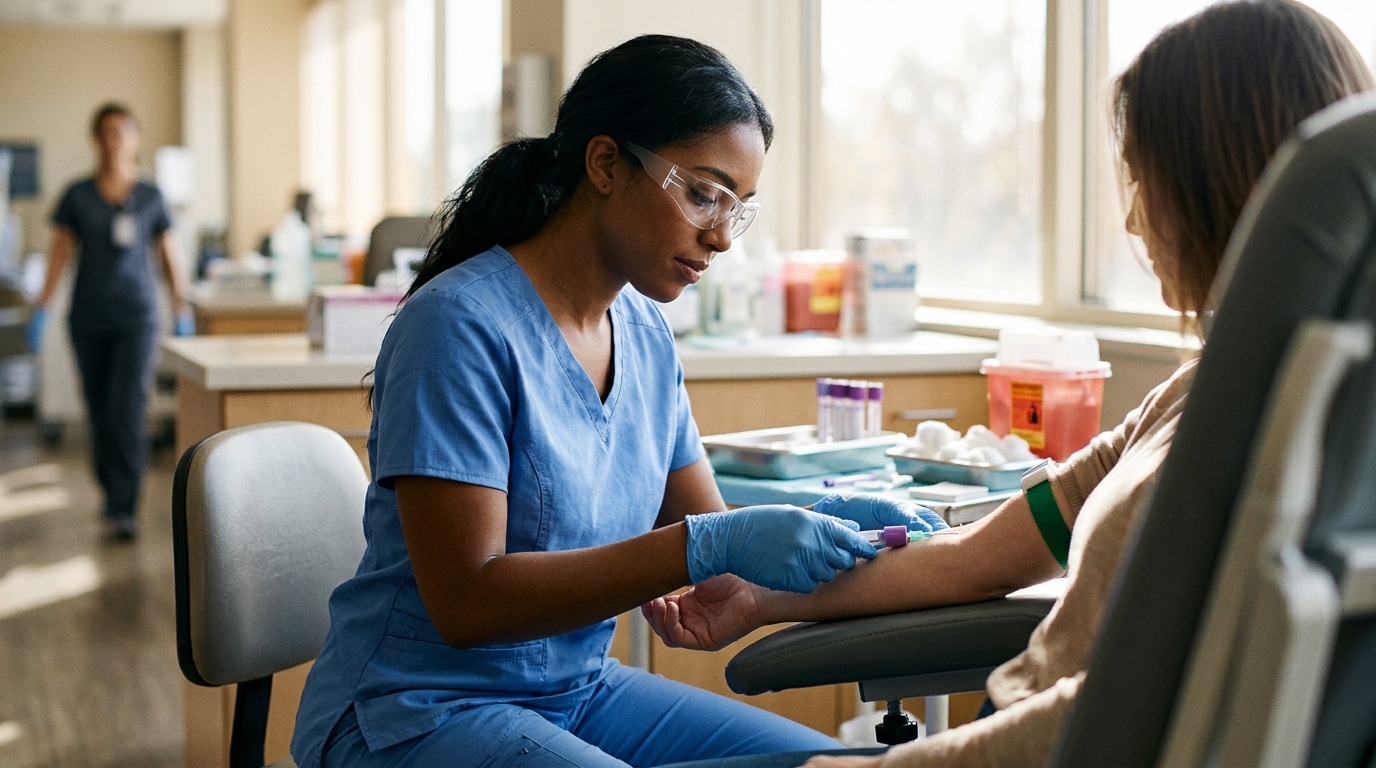
A phlebotomist collects blood from patients and donors so it can be tested, transfused, or stored. The work pairs one technical skill — finding a vein and drawing a usable sample — with identity checks, labeling, and infection control, usually in a hospital, medical or diagnostic laboratory, blood donor center, or doctor's office (U.S. Bureau of Labor Statistics, 2025).
Entry normally runs through a short training program and a certification exam rather than a degree (U.S. Bureau of Labor Statistics, 2025).
What a Phlebotomist Does
A phlebotomist collects blood samples that someone else will test, transfuse, or store. You work where the blood is needed: hospital inpatient floors and emergency departments, medical and diagnostic laboratories, blood donor centers, and doctors' offices (U.S. Bureau of Labor Statistics, 2025).
In a hospital you work from a draw list and visit patients at the bedside. In an outpatient draw station or physician's office, patients come to you with a requisition from their doctor. In a donor center you screen and draw healthy volunteers, and the unit you collect goes into the blood supply.
The clinical skill is venipuncture — vacuum tube, syringe, or butterfly method (O*NET OnLine, U.S. Department of Labor) — but accuracy counts just as much. You verify identity against the order, talk people through their nervousness, label every tube at the bedside, and enter patient information into the laboratory database (U.S. Bureau of Labor Statistics). Employers also advertise the role as Patient Service Technician, Mobile Examiner, or Lab Liaison Technician (CareerOneStop, U.S. Department of Labor).
Core Duties and Responsibilities
- Draw blood from veins by vacuum tube, syringe, or butterfly venipuncture, the most frequent technical task in the role (O*NET OnLine, U.S. Department of Labor).
- Perform capillary collections, such as finger sticks, when a venous draw is not suitable.
- Verify patient identity against the test order or requisition before any needle goes in.
- Label each tube at the bedside and enter the draw in the patient database.
- Dispose of contaminated sharps under applicable laws, standards, and policies — rated importance 100 among phlebotomist tasks (O*NET OnLine, U.S. Department of Labor).
- Organize and clean blood-drawing trays, confirming instruments are sterile and needles and syringes are first-time use (O*NET OnLine, U.S. Department of Labor).
- Assemble and maintain needles, holders, test tubes, tourniquets, and gauze (U.S. Bureau of Labor Statistics).
- Flag short-draw, hemolyzed, or mislabeled specimens and arrange a recollection.
A Typical Day
Start of shift: Check the draw list, stock your tray with tubes, needles, alcohol pads, gauze, and labels, and confirm the sharps container has capacity.
Early morning rounds: Work through inpatient draws before meal trays and physician rounds — identity check, tourniquet, draw, label, document, repeat.
Mid-morning: Deliver or tube specimens to the lab, then pick up stat orders from the emergency department or ICU.
The unpredictable part: A patient with scarred or collapsed veins, a child who will not hold still, or someone who faints mid-draw. You stop, position the patient safely, and either reattempt with a butterfly set or hand off to a second phlebotomist per facility policy.
Afternoon: Cover walk-ins at the draw station, handle add-on tests and recollections, restock the cart.
End of shift: Dispose of sharps, disinfect surfaces, hand off outstanding orders.
Work Environment
- Indoors in clinical settings — hospitals, medical and diagnostic laboratories, blood donor centers, and doctors' offices (U.S. Bureau of Labor Statistics, 2025).
- On your feet most of the shift, walking between rooms and pushing or carrying a drawing tray; seated mainly when drawing at a phlebotomy chair.
- Most phlebotomists work full time, and nights, weekends, and holidays are common depending on the setting (CareerOneStop, U.S. Department of Labor). Hospital labs run around the clock; physician offices usually keep weekday hours.
- Routine contact with blood and bodily fluids, so gloves, eye protection, and rigid sharps containers at the point of use are standard.
- Noise ranges from quiet draw rooms to monitors, alarms, and overhead pages on hospital floors.
- Mobile Examiner and donor-drive roles involve driving to homes, workplaces, or collection sites; the share of travel varies by employer, so check the posting (CareerOneStop, U.S. Department of Labor).
Skills and Qualifications
| Requirement | Detail |
|---|---|
| High school diploma or equivalent | Standard starting point before a training program. |
| Postsecondary nondegree award in phlebotomy | The typical entry-level education for the occupation (U.S. Bureau of Labor Statistics, 2025). Most people take a short technical training program, then test to become certified (CareerOneStop, U.S. Department of Labor); length varies by school, so confirm with the provider. |
| Prior work experience | No related work experience and no on-the-job training is typically required to enter (U.S. Bureau of Labor Statistics, 2025). Individual postings differ — one part-time hospital posting required 1 year of phlebotomy experience (CareerOneStop / Griffin Health posting, 2025). |
| Certified Phlebotomy Technician (CPT), National Healthcareer Association | A national certification for the occupation (O*NET OnLine, U.S. Department of Labor). Eligibility requires at least 30 successful venipunctures and 10 capillary or finger sticks on live individuals (Phlebotomy Career Training). The exam has 120 items — 100 scored, 20 pretest — in two hours (Open Exam Prep, 2026). |
| Phlebotomy Technician (PBT), American Society for Clinical Pathology | Also listed for the occupation (O*NET OnLine, U.S. Department of Labor). The most common route requires an approved training program plus 100 successful, unaided blood collections (Phlebotomy Career Training). |
| State phlebotomy certification | California, Washington, Nevada, and Louisiana require a state-issued certification in addition to a national credential; California issues the CPT-1 or CPT-2 through its Department of Public Health (PhleboPrep, 2026). |
Salary and Job Outlook
| Measure | Detail |
|---|---|
| Entry-level pay | No separate national starting figure is published. Pay is hourly, often with shift differentials for nights and weekends; check the 10th and 25th percentile wages for your state in the current Occupational Employment and Wage Statistics tables (U.S. Bureau of Labor Statistics). |
| Median pay | $45,230 a year, or $21.75 an hour (U.S. Bureau of Labor Statistics, 2025). |
| Experienced pay | Best checked in state and percentile tables. For scale, California had the highest state annual mean wage at $52,370, an hourly mean of $25.18 (U.S. Bureau of Labor Statistics, May 2023). |
| Projected growth | 7 percent from 2025 to 2035, much faster than average for all occupations (U.S. Bureau of Labor Statistics, 2025). |
| Annual openings | About 18,000 a year on average over the decade (U.S. Bureau of Labor Statistics, 2025). |
How to Get Started
- Finish high school or an equivalent, then check your state's rules. In California, Washington, Nevada, and Louisiana a state-issued certification is required on top of a national credential, and California issues the CPT-1 and CPT-2 through its Department of Public Health (PhleboPrep, 2026).
- Enroll in a phlebotomy training program leading to a postsecondary nondegree award — the typical entry-level education for the role (U.S. Bureau of Labor Statistics, 2025) — and confirm it includes supervised live draws.
- Log your clinical sticks: at least the 30 venipunctures and 10 capillary sticks required for National Healthcareer Association CPT eligibility, or the 100 unaided collections on the main ASCP PBT route (Phlebotomy Career Training).
- Sit the exam. The NHA CPT runs 120 items in two hours (Open Exam Prep, 2026); the ASCP Phlebotomy Technician (PBT) is the other national option listed for the occupation (O*NET OnLine, U.S. Department of Labor).
- Apply to hospitals, laboratories, blood donor centers, and physician offices, searching alternate titles such as Patient Service Technician, Mobile Examiner, and Registered Phlebotomist (CareerOneStop, U.S. Department of Labor).
Frequently asked questions
Do you need a college degree to become a phlebotomist?
No. The typical entry-level education is a postsecondary nondegree award, and no work experience in a related occupation is typically required to enter (U.S. Bureau of Labor Statistics, 2025). Most people finish a short technical training program and then test for a credential such as the National Healthcareer Association's Certified Phlebotomy Technician (CareerOneStop, U.S. Department of Labor).
Is certification legally required?
It depends on your state. California, Washington, Nevada, and Louisiana require a state-issued phlebotomy certification in addition to any national credential, and California issues the CPT-1 or CPT-2 through its Department of Public Health (PhleboPrep, 2026). Elsewhere it is often an employer preference — one part-time hospital posting listed certification as preferred while requiring 1 year of experience (CareerOneStop / Griffin Health posting, 2025).
How many blood draws do you need before you can get certified?
The National Healthcareer Association's CPT route requires a minimum of 30 successful venipunctures and 10 capillary or finger sticks on live individuals, while the most common ASCP Phlebotomy Technician route requires an approved training program plus 100 successful, unaided collections (Phlebotomy Career Training). Check which credential your program prepares you for, since your clinical site has to supply those opportunities.
What hours do phlebotomists work?
Most work full time, and nights, weekends, and holidays are common depending on the setting (CareerOneStop, U.S. Department of Labor). Hospital labs and donor centers operate around the clock, so early inpatient draw rounds are routine, while physician offices and outpatient draw stations generally keep weekday daytime hours.
Is the job growing?
Employment is projected to grow 7 percent from 2025 to 2035, much faster than the average for all occupations, with about 18,000 openings projected each year on average over the decade (U.S. Bureau of Labor Statistics, 2025). Many of those openings come from workers moving into other roles or leaving the labor force rather than from newly created positions.
Sources
- U.S. Bureau of Labor Statistics — Phlebotomists : Occupational Outlook Handbook (2025)
- U.S. Bureau of Labor Statistics — Phlebotomists : Occupational Outlook Handbook